U.K. イギリス Vol.25(England イングランド Vol.7 – East of England イーストオブイングランド地方)

All the below links are in English or Japanese.

Norfolk、Suffolk、Hertfordshire、
Luton を含む Bedfordshire、
Thurrock 及び Southend-on-Sea を含むEssex、
Peterborough を含む Cambridgeshire、です。

Cambridgeshire including Peterborough
UK Vol.120 (England Vol.13 – East of England Vol.6) – Cambridgeshire including Peterborough –
UK Vol.119 (England Vol.12 – East of England Vol.5)
UK Vol.118 (England Vol.11 – East of England Vol.4) – University of Cambridge –
Cambridge’s Silicon Fen shaken by the winds of change (23/07/2016) | @TerryMac999 @guardian
Japan working with UK companies (21/10/2011) | Cambridgeshire Chambers of Commerce
It’s a new day for Sosei Heptares (19/10/2018) | Mike Scialom @CambridgeIndy
University of Cambridge Kendo Society | @Cambridge_Uni
£2,000 Japanese gin is ‘world’s most expensive’(19/11/2015) | Amy Hopkins @spiritsbusiness
Sushi wars are hotting up in Cambridge as another restaurant opens in the city (23/06/2018) | Raymond Brown @Cambslive
On the market: 1980s Japanese-style single-storey property in Cambridge, Cambridgeshire (11/25/2013) | @WowHauser
英国産「SAKE」で日本発信 欧州で初の酒蔵完成、富裕層中心に商機狙う (09/15/2018) | 産経新聞

Essex including Thurrock and Southend-on-Sea
UK Vol.117 (England Vol.10 – East of England Vol.3)
Japanese specialist plastics company opens first UK premises in Essex | @investessex
Olympus Keymed | @investessex
The Japan-British Exhibition of 1910 (03/06/2019) | ESSEX GARDENS TRUST
New links forged with Japan through Vice-Chancellor’s visit (02/03/2017) | @Uni_of_Essex
University of Essex | 国際教養大学
Japanese Roof Garden | @SOAS
エセックスサマースクール2017を早稲田大学で開講しました ‐スーパーグローバル大学創成支援「Waseda Ocean構想」 (11/07/2017) | 早稲田大学
エセックス大学 | 獨協大学

Hertfordshire and Bedfordshire including Luton
UK Vol.116 (England Vol.9 – East of England Vol.2)
Japanese food comes to Hertford with Oishii by Elle (03/08/2017) | @hertslife
Hertfordshire fire officer leads UK Japan rescue team (14/03/2011) | @BBC
Wasabi launches first UK airport outlet at Luton (21/09/2015) | Caterlyst
Japanese garden wins award (09/08/2011) | Bedford Today
Case Study: Nissan Technical Centre Europe, Cranfield Technology Park, Bedfordshire (PDF) | @BruelKjaerUK
Impact case study (REF3b) – Institution: University of Bedfordshire | #REF2014
cf.
Japan: The World’s First Post-Growth Economy? (01/02/2011) | Jeremy Williams @postgrowth
Was this Thatcher’s greatest legacy? (14/09/2009) | Giles Edwards @BBC

Norfolk and Suffolk
UK Vol.115 (England Vol.8 – East of England Vol.1)
Global Perspectives: East Anglian heritage is ‘big in Japan’ (09/12/2017) | Trevor Heaton @EDP24
Japanese distillers come to Norfolk for Maris Otter | @HBanhamLTD
British parts supplier to open largest Honda motorcycle museum outside Japan (01/28/2015) | Kurt Ernst @HemmingsNews

U.K. イギリス Vol.24(England イングランド Vol.6 – East Midlands イーストミッドランズ地方)

All the below links are in English or Japanese.

ウェストミッドランズの東隣地域、イーストミッドランズです。以下のとおり東西3州ずつ分けてみましたが、これまで同様、特に行政的にそのように分けられているということはありません。

東3州
UK Vol.96 (England Vol.7 – East Midlands Vol.2) – Lincolnshire, Rutland, and Northamptonshire –

Lincolnshire リンカーンシャー州 サッチャー元首相の出身地
First events programmed for Lincoln Japan Festival revealed – and yes, the MOST popular from 2017 is back (16/01/2018) | Dawn Hinsley @LincsLive
£2bn Lincolnshire wind farm takes a step closer as Japanese take stake (08/13/2018) | Sam Metcalf @TBDEastMidlands

Rutland ラトランド州
Kyoto – A Taste of Japan | @info_cookery

Northamptonshire ノーサンプトンシャー州 靴製造で有名
Shoe firm Tricker’s opens Tokyo store (25/04/2019) | @BBC
About British Kendo Association | @Nsport

西3州 “スティルトン チーズ” の3州である、というのは確かです。
UK Vol.84 (England Vol.6 – East Midlands Vol.1) – Derbyshire, Nottinghamshire, and Leicestershire –
Here you can check out sites related to “Stilton cheese” as well.

Derbyshire ダービーシャー州
なお、競馬用語 “ダービー” は、第12代目ダービー伯爵(サリー州出身)に由来する、とされています。
Toyota to build new Suzuki car at Burnaston factory (20/03/2019) | @bbcemt
Toyota City, Japan | @Derbyshirecc
Westminster visit promotes importance of twinning of Derbyshire and Toyota City (13/09/2018) | @DerbyUni
Derbyshire schools to receive Japanese Sakura cherry trees (21/02/2019) | @chesterfielduk
University of Derby research visit to Japan (20/09/2018) | @EMChamberNews
International Ambassadors experience Japanese summer (01/10/2018) | @BSDCofficial
Big in Japan: Derbyshire-designed headphones tae off in Tokyo (09/12/2014) | @sparky000
トヨタ 欧州向け新型カローラを英ダービーシャーにて生産開始 (01/15/2019) | @carviewcojp
日本ブランドを選ぶ英国人自動車購入者が3分の1増加し、日英の自動車貿易は引きつづき強固 (11/02/2017) | @SankeiBiz_jp
姉妹都市ダービーシャーのご紹介 (観光情報) | 豊田市
イギリス・ダービー大学と心理学部の共同研究が始まる (08/03/2018) | 中京大学

Nottinghamshire ノッティンガムシャー州
Japanese tourists visit first Bramley tree in Southwell (23/08/2012) | @BBC
Japanese Water Gardens
イギリス留学を通じて- Nottingham Trent 大学 (PDF) | @ 豊田工業大学
イギリスにおけるタウンセンターファースト政策を支える必要性の評価と影響評価 (PDF; 11/2013) | @ 公益社団法人 日本都市計画学会

Leicestershire レスターシャー州
British cheese now a ‘status symbol’ in the US and Japan (06/04/2018) | Katie Morley @Telegraph
Burleighs unveils pink gin inspired by Japan (12/08/2016) | Annie Hayes @SpiritsBusiness
Norton Motorcycles makes £20m Japan export deal (11/01/2019) | @LLEPnews
Japanese princess found secretly living in Leicester (20/09/2015) | David Trayner @Independent
Anime (LANMA) | @UoLActivities
レスター残留が決まった岡崎慎司…地元メディアに決意語る! (02/02/2019) | @footballtribejp
まだ終わりじゃない。岡崎慎司、 レスター退団を明言して燃やす向上心 (04/02/2019) | @webSportiva
【導入事例】レスターシャー州警察 | イプロス

U.K. イギリス Vol.23(England イングランド Vol.5 – West Midlands ウェストミッドランズ地方 Vol.2)

All the below links are in English or Japanese.

ウェストミッドランズの東3州です。こちらも、スタッフォードシャーブルテリア、シェイクスピアの出身地、そしてイギリス第二の大都市、とそれぞれ知られています。

UK Vol.79 (England Vol.5 – West Midlands Vol.2)

Staffordshire スタッフォードシャー州
Fragments of a global puzzle (07/14/2017) | @nationaltrust
Staffordshire University in your country | @StaffsUni

Warwickshire ウォーリックシャー州
Binley Business Innovation Centre | @WarwickSP  cf. https://denka-seiken.com/contact-us/
HORIBA MIRA, Ltd. @MIRAEngineering に先進的排ガス試験設備を開設 (07/07/2017) | @HORIBA_jp
アストンマーティン、英国に新たな車両開発施設を開業 (01/26/2015) | @responsejp
協定校・機関 (PDF; 05/01/2018) | 立命館大学

West Midlands (county) including Birmingham city and metropolitan borough バーミンガムを含むウェストミッドランズ州
英国バーミンガムで始まった「エネルギーキャピタル計画」とは (23/03/2017) | @tradegovukJPN
JR東日本、英国で鉄道運行「1年間の通信簿」 日本が誇る「鉄道力」はどこまで浸透したのか (12/25/2018) | @Toyokeizai
デイヴィッド・キャメロン首相、ジャガー・ランドローバーの エンジン製造センターを視察 (02/21/2014) | Jaguar Land Rover Japan Media Centre
【イギリス】電気自動車普及の官民連携プロジェクト「Go Ultra Low」、賛同企業が100社を突破 (08/30/2017) | @SustainableJPN
アストンマーティン、日本との貿易取引および投資額として5億ポンドを策定 (08/30/2017) | ASTON MARTIN HIROSHIMA
アストン・サイエンス・パーク(1) (PDF) | 鈴木茂 @Matsudai_koho
早稲田大学におけるバーミンガム大学デー開催
イギリス独占形成期の機械工業(1) -ウェスト・ミッドランズ地方を中心として- | 山本尚一 @ 香川大学
国際交流協定校 | @ 東洋大学
Japan | @MyBCU
Cost of Living Comparison Between Birmingham and Tokyo
https://twitter.com/WSlightly/status/1120188688133021701

U.K. イギリス Vol.21(England イングランド Vol.3 ― Yorkshire and the Humber ヨークシャーアンドザハンバー地方)

All the below links other than those in Japanese are in English.

標記につき、以下貼っておきます。

UK Vol.71 (England Vol.3 – Yorkshire and the Humber)

North Yorkshire
ヨークシャー・デールズ(Yorkshire Dales)| @VisitBritain
ヨーク大学
ヨーク大学Jane Grenville副学長来訪 | 東北大学国際交流課

East Riding of Yorkshire
Van Gogh and Japan at Spotlight Theatre | @VHEY_UK
ハル大学

West Yorkshire
Chiharu Shiota: Beyond Time | @YSPsculpture
リーズ大学
国際蛋白研セミナー(英国・日本二国間交流事業) “Integrative Structural Biology for Protein Science”| 大阪大学蛋白質研究所
ブラッドフォード大学

South Yorkshire
New future for endangered Japanese Bears | @YorkshireWP
シェフィールド大学
シェフィールド大学、地球規模の課題に対処するため日本との関係を強化 | @cnet_japan


https://twitter.com/kizame_sekaini/status/1116842440122462209


https://twitter.com/menyaclear/status/1070154889316069377


https://twitter.com/Kazz_UK/status/1099421652935426052

Ireland アイルランド Vol.7(州 counties)

Ireland GreenYellow

All the below links are in English.

取り急ぎ、標記につき今までにまとめたものを以下貼っておきます。

Ireland Vol.43 (Leinster Vol.10 – City of Dublin Vol.3)

Ireland Vol.42 (Leinster Vol.9 – City of Dublin Vol.2)

Ireland Vol.41 (Leinster Vol.8 – City of Dublin Vol.1)

Ireland Vol.36 (Leinster Vol.7 – Fingal)

Ireland Vol.35 (Leinster Vol.6 – South Dublin)

Ireland Vol.34 (Leinster Vol.5 – Dún Laoghaire – Rathdown)

Ireland Vol.33 (Leinster Vol.4 – Wicklow, Kildare)

Ireland Vol.32 (Leinster Vol.3 – Meath, Louth)

Ireland Vol.31 (Leinster Vol.2 – Laois, Offaly, Westmeath, Longford)

Ireland Vol.30 (Leinster Vol.1 – Kilkenny, Carlow, Wexford)

Ireland Vol.22 (Munster Vol.3 – Tipperary, Waterford)

Ireland Vol.21 (Munster Vol.2 – Kerry, Cork)

Ireland Vol.20 (Munster Vol.1 – Clare, Limerick; #StPatricksDay)

Ireland Vol.19 (Connacht Vol.2 – Mayo, Galway)

Ireland Vol.18 (Connacht Vol.1 – Leitrim, Sligo, Roscommon)

Ireland Vol.17 (Ulster – Donegal, Cavan, Monaghan)

Pinned tweets, etc. 固定ツイート等

アイルランドの政治・行政・企業・地方・大学: 英文脚注15000以上―アイルランド・米国・英国・欧州・日本企業情報を含む Kindle版 中港拓 (著)

#FoodexJapan2019 non-Japanese companies #フーデックスジャパン2019 外国企業(於:幕張メッセ Makuhari Messe)
https://twitter.com/WSjp_insight/status/1115147825342345217
U.K. イギリス Vol.18(北アイルランド Northern Ireland)
U.K. イギリス Vol.19(スコットランド Scotland)
U.K. イギリス Vol.20(ウェールズ Wales)

U.K. イギリス Vol.16(Brexit Vol.13:報道等において正面から触れられていないブレグジット三点 3 points concerning Brexit which have not been confronted in the media etc.)
U.K. Vol.17(Brexit Vol.14: 3 points concerning Brexit which have not been confronted in the media etc. – especially outside the United Kingdom and the Republic of Ireland)


EU-Japan Economic Partnership Agreement 日EU経済連携協定(EUJEPA)Vol.2


EUJEPA Vol.3
TPP Vol.4
TPP Vol.5
TPP Vol.6


ツイート:サイバーセキュリティ


SNSは複雑単純あるにしてもどれでも使い続けないと正直よく分からないものであると認識していますが、当方が唯一使い続けているツイッターの良さは
1.設定が全体に自由かつ簡単であり、また、それゆえもあり拡散力に優れてもいる
2.そのため、難しい話を内容とするディスカッション、コンテンツマーケティング、キュレーションに適している。
こういう良さを備えるSNSは、今後も出て来ないように感じます。
そもそも、情報が有り過ぎて困る今の時代には、ある意味キュレーション無くして物事の正確な理解はできません。
この意味では、キュレーション等のためのツイッターも、その存在無くして今の時代を語れないとも言い得ます。
フォロワー数やリツイート数・ライク数よりも、コンテンツの質が重要とも言えます。

https://twitter.com/WSjp_insight/status/1106487409204555776
Honestly, we have understood that it is difficult to understand how to use social network services, if we don’t keep using some specific ones, regardless of being complicated or simple. The strengths of Twitter, which we have kept using as our single tool, would be:
1. in general, we can set it freely and easily, and so forth as well, it is good at spreading stories on the Internet;
2. therefore it is suitable to discussions, content marketing, curation, etc. on difficult topics or contents.
It seems that there will not be such strong services other than Twitter.
Today, when there is too much information, in a sense, it is impossible to accurately understand news without curation.
In this sense, it would be impossible to talk about current era without presense of Twitter, which is suitable to curation, etc.
We can say that the quality of contents is far more important than the numbers of followers, retweets, likes, etc.

ご参考:
1.(無料で使用しているので思うような表示にはなっておりませんが)一応、https://9223.teacup.com/ireland_corps/bbs という(概ね日本語 Mostly in Japanese の)デジタルサイネージ digital signage があります。アイルランド関連・電子書籍関連に可能な限り絞って貼って行こうと考えています。
2.https://www.goodreads.com/world_solutions (in English)
これは引き続き、若干趣味的に試行錯誤の最中です。フィクション作品愛好者が圧倒的に多い、更新後の内容が表れるのが半日くらい後である、などの特徴があると言えそうです。
3.2019年4月16日、書籍Facebookページを公開停止といたしました。今までご覧頂いた等の方々、誠にありがとうございました。引き続き、本ウェブサイトやツイッター等をご覧頂ければ幸甚です。
On April 16, 2019, we stopped publishing the eBook-related Facebook page. Thank you so much for having visited that page, etc. We would be very pleased if you continue visiting this website, Twitter accounts, the Teacup digital signage, etc.

EUJEPA Vol.4 / TPP Vol.7 (チーズ、牛肉、シーフード、ワイン Cheese, Beef, Seafood, Wine)

取り急ぎ標記につき以下貼っておきます。

English
Cheese
Beef
Seafood
Wine

日本語


https://twitter.com/txbiz_ondemand/status/1095975961810526208


https://twitter.com/EmbEspJapon/status/1019149054498910208
https://twitter.com/EUinJapan/status/1062186435736936448


https://twitter.com/franceiine/status/1091127440242442240

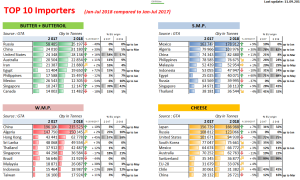
cf. Cheese, etc., Top 10 Importers
EUJEPA-TPP cheese top-10-importers

France フランス Vol.1

Most of the below links (incl tweets) are in English.

取り急ぎ以下貼っておきます。

France Vol.3 (Finance)
France Vol.4 (Finance)
France Vol.5 (Brands)
France Vol.6 (Food)
France Vol.7 (Pharma/Health/Biotech/Food)
France Vol.8 (Energy/Utilities, Airplane/Train)
France Vol.9 (Digital/Telecommunications/Media)
France Vol.10 (Automobile)
France Vol.11 (United States)
France Vol.12 (U.S., Canada, U.K.)
France Vol.13 (Government, diplomacy, Ireland, technology, etc.)
France
https://twitter.com/WSjp_insight/status/1058629307210194944
France Vol.2 (2017 French Presidential Elections)
France Vol.1 (France regions, history, technology, et al.)

https://twitter.com/BFrance_Japan/status/1077757150947168257
https://twitter.com/ambafrancejp_jp/status/1078817878151856130


https://twitter.com/francediplo_EN/status/1077157080430186502


https://twitter.com/OECD/status/1078652120096743424


https://twitter.com/armeedeterre/status/978296480678207489
https://twitter.com/armeedeterre/status/973928625945956353
https://twitter.com/armeedeterre/status/947842288566308866


https://twitter.com/AgnesRunacher/status/1078328738335514626


https://twitter.com/Place_Beauvau/status/1075752233277505536


https://twitter.com/Min_Ecologie/status/1076071355706163205
https://twitter.com/franceintheus/status/1074390960682008576


https://twitter.com/CampusFrance/status/1052563186807988225
https://twitter.com/DWIH_Tokyo/status/1068791816982548480

TPP Vol.6

All the below links and excerpts (incl 5 pictures) are in English.

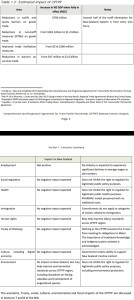
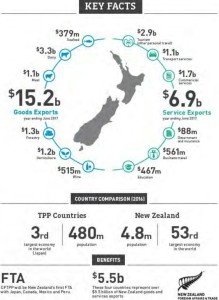
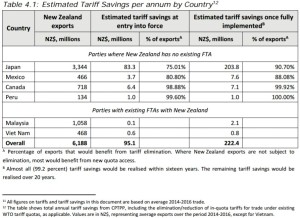
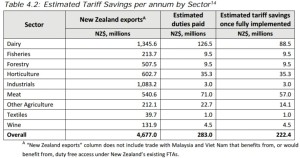
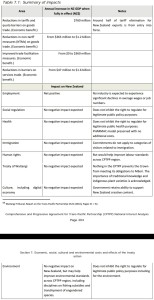
Comprehensive and Progressive Agreement for Trans-Pacific Partnership – National Interest Analysis @ NZ MFAT (PDF; 03/2018) You can check out the below pictures (Tables, etc.) as well.
p4 Table 1.1: Exports from New Zealand to new FTA partners
pp5-6 Table 1.2: Estimated impact of CPTPP
p8 KEY FACTS, etc.
p16 Japan is New Zealand’s fifth largest export market and it is a high value one for exporters. In the year to June 2017 two-way trade stood at NZ$7.9 billion. New Zealand exports to Japan were NZ$4.0 billion, accounting for 5.5 percent of our total exports. The trading relationship is highly complementary with New Zealand supplying food and industrial materials, such as wood and aluminium, and Japan exporting finished industrial goods and machinery to New Zealand. The CPTPP will help New Zealand agriculture exporters in particular overcome high MFN tariff rates into Japan. Japan is also New Zealand’s fifth largest source of foreign direct investment, with significant investments in the forestry sector. Services exports are another big part of our trading relationship, with Japan a top-five source of students and tourists.
p19 … There are already competitors that enjoy lower barriers to trade relative to New Zealand businesses in key CPTPP markets (e.g. Australia in Japan) and more will follow as other free trade agreements are realised (e.g. the EU-Japan FTA). …
p22 Table 4.1: Estimated Tariff Savings per annum by Country
p23 Table 4.2: Estimated Tariff Savings per annum by Sector
pp23-24
• At entry into force (Year 1): tariffs eliminated on NZ$1.4 billion of New Zealand exports currently subject to tariffs, including many horticultural and forestry goods, a number of dairy products, some wine, many manufactured products, and much fish and seafood. Specific product examples include such items as: Japan (kiwifruit, squash); Canada (wine); Mexico (mussels, kiwifruit, milk albumin); and Peru (buttermilk powder). As a result, 79.8 percent of New Zealand exports to these new FTA markets would enter duty free on the day the CPTPP enters into force, with estimated tariff savings for New Zealand exporters of NZ$95.1 million.
• By the 5th year after entry into force (Year 6): tariffs eliminated on an additional NZ$111.2 million of New Zealand exports currently subject to tariffs, including: … Japan (hoki and other frozen fish, carrot juice, sausages and mandarins) … 2.4 percent of total current New Zealand exports to … 82.2 percent … Estimated total tariff savings in the fifth year after entry into force are NZ$148.1 million.
• By the 10th year after entry into force (Year 11): tariffs eliminated on an additional NZ$175.0 million … Japan (tongues, hides, bluefin tuna and apples) … 3.7 percent … 85.9 percent … NZ$186.9 million.
• By the 15th year after entry into force (Year 16): tariffs eliminated on an additional NZ$220.8 million … Japan (cheese, sawn wood and offal) … 4.7 percent … 90.6 percent … NZ$220.6 million.
• When fully phased in: tariffs eliminated on an additional NZ$71.9 million of New Zealand exports currently subject to tariffs. The total tariff savings from the CPTPP are estimated to be NZ$222.4 million per year at full implementation, not taking account of dynamic impacts.
pp24-25
• Tariff reductions: Tariffs on an additional NZ$207.1 million of goods exports would be significantly reduced, but not eliminated, allowing for improved market access. This includes beef exporters that would benefit from a 77 percent reduction in Japan’s tariff for beef. This tariff would be reduced from the current 38.5 percent duty to 9 percent over sixteen years, with an initial sharp cut at entry into force, to 27.5 percent. There will be a transitional volume-based safeguard applying to all CPTPP beef imports into Japan, set above current trade levels, with a growth rate. The safeguard will be abolished by Year 20 at the earliest. The new CPTPP safeguard would remove the potential for Japan’s WTO beef safeguard to be applied to New Zealand’s exports. That safeguard was exceeded in 2017 meaning that a higher ‘snap-back’ tariff of 50 percent is being applied to New Zealand exports through to 31 March 2018 placing New Zealand beef exporters at a significant disadvantage to other countries (e.g. Australia) that have an FTA with Japan. This outcome is the best outcome that Japan has agreed in a FTA to date, and would help re-establish a level playing field with Japan’s largest beef supplier, Australia, after the Japan-Australia Economic Partnership Agreement entered into force in early 2015.
Japan will also reduce the tariff for ice-cream by two-thirds, from 21 percent today to 7 percent over six years, opening up new export opportunities given the significantly reduced tariff.
p26 Table 4.3: Estimated Total Volume of CPTPP Quota Access available to New Zealand Exporters
By Year 10 of the CPTPP Agreement entering into force:
• Japan will provide 40,200 MT of predominately CPTPP-wide access, with 14,000 MT on priority products for New Zealand including butter and powders. Japan is also eliminating tariffs for most cheese over sixteen years.
p27 … For country-specific access into Japan, tariffs on WTO trade are eliminated over 21 years after entry into force, with an 80 percent reduction in the first 11 years. …
… Given the scale of some of the tariff benefits from CPTPP that would, in this scenario, accrue to New Zealand’s competitors inside CPTPP, but not New Zealand – e.g. Japan’s reduced beef tariffs, or tariff elimination on Japanese cheese tariffs – New Zealand exporters would likely lose significant market share to other CPTPP exporters if New Zealand were not part of CPTPP.
p53 … The CPTPP also builds on the opportunities New Zealand businesses secured under the WTO Agreement on Government Procurement (GPA), with some modest improvements to access in Canada, Japan and Singapore (e.g. additional entities and coverage of private-public-partnerships). …
pp86-87 Export restrictions – food security
In Article 2.26, Parties acknowledge that countries may temporarily apply an export prohibition or restriction on foodstuffs where there is risk of a critical shortage as set out in Article XI of the GATT 1994 and Article 2.1 of the Agreement on Agriculture. Further to this, the Parties agree that if a CPTPP country is a net exporter of a foodstuff and imposes an export prohibition or restriction on the foodstuff from another CPTPP country in these circumstances, it must notify all of the other Parties before the measure comes into force. Notification must include the reason that the measure was imposed or maintained, how the measure is consistent with the GATT and any alternative measures the Party considered imposing. Any Party that has a substantial interest as an importer of that foodstuff may request consultations with, or data relating to the critical food shortage from, the Party imposing or maintaining the measure.
Any measure that is notified under this procedure should ordinarily be removed within four to six months. If a Party is considering extending the measure for longer than this, further notification must be provided to the other CPTPP countries. Measures may only be continued for longer than twelve months if all other Parties that are net importers of the relevant foodstuff have been consulted. A measure must be discontinued immediately if the critical shortage, or threat of critical shortage, no longer exists.
These measures may not be applied to food purchased for non-commercial humanitarian measures.
p95 Global safeguards
pp105-107 Wine and Distilled Spirits Annex
pp204-205 Table 7.1: Summary of impacts
p207 New Zealand exporters have direct experience of this kind of competitive displacement caused by being on the outside of preferential access enjoyed by competitors. For example:
• Since the entry into force of the Australia-Japan FTA, New Zealand beef exports to Japan have dropped by over 25 percent, with New Zealand exporters losing market share to their Australian competitors who are only beginning to enjoy tariff preferences under the FTA.
• Following the entry into force of the Korea-US FTA, US beef exports increased 25 percent. New Zealand exports declined by almost NZ$50 million. The US’ share of the Korean cheese import market has also grown from 41 percent to 74 percent.
• Until the entry in force of the New Zealand-Korea FTA, kiwifruit exporters paid a 45 percent tariff on kiwifruit. Their Chilean competitors enjoy duty-free access.
• Prior to the NAFTA agreement being signed by Canada, Mexico and the US in the 1990s, New Zealand was a significant supplier of dairy products to Mexico. Since Mexico eliminated tariffs for US dairy products, New Zealand’s share of Mexico’s cheese imports declined from 20 percent to 4 percent, and our share of milk powder imports from 25 percent to less than 10 percent.
ImpactEcon et al modelled the economic impact of the CPTPP by first estimating how New Zealand’s economy would be expected to develop as part of the global economy in the absence of CPTPP, and comparing this to the case where CPTPP liberalised trade in goods and services in four areas. The result of the CGE model takes account of the complicated adjustments that might take place in an economy following new trade flows and resource allocation. The four ways in which CPTPP was assumed to liberalise trade were:
• Reductions in tariffs and quota barriers on goods trade.
• Reductions in non-tariff measures on goods trade.
• Improved trade facilitation measures.
• Reductions in barriers on services trade.
pp207-211
pp221-225 8 The costs to New Zealand of compliance with the treaty
pp239-243 Overview of the suspensions

Latin American Perspectives on the Trans-Pacific Partnership (TPP) (PDF; 09/02/2016) | NEW ZEALAND CENTRE FOR LATIN AMERICAN STUDIES, School of Cultures, Languages and Linguistics, University of Auckland
“Is the TPP a mega-NAFTA that will devastate Mexico?” Daniel Villafuerte Solis, The Centre for Advanced Studies in Mexico and Central America (CESMECA)
The agro-food sector, the most hard-hit by NAFTA, could suffer a new beating under the TPP. To put this into context, let us remember some figures from the Bank of Mexico: in 2014, the Mexico had a trade deficit for agro-food and agro-industrial products of US $2.593 billion, an amount equivalent to 40% percent of the budget assigned that year to the Secretariat of Agriculture, Livestock, Rural Development, Fisheries and Food (SAGARPA).
The figures for imports by sector are frightening: between 2010 and 2014, imports of milk, diary, eggs and honey grew by 57.% totalling more than 2 billion dollars in 2014; meat and edible meat offal imports grew by 42.5% to $4.596 billion; cereals grew by 31.6% reaching $4.259 billion; and imports of legumes grew by 15.3%. Together, imports in these four sectors grew from $10.751 billion to $14.342 billion, an increase of 33.4%.
“What is the Trans-Pacific Partnership all about?” Alejandro Villamar, Mexican Action Network on Free Trade (RMALC)
To give just some examples of recent analyses of the potential impacts on food sovereignty, agriculture and health, the TPP would result in illegal contamination of foodstuffs by genetically modified organisms, and a new report questions the rules of food security and animal health in the TPP (http://goo.gl/SKKbqe).
“The TPP: Bad news for farmers and agriculture” Karen Hansen-Kuhn, Institute for Agriculture and Trade Policy
The bad news is that the TPP expands many of the worst features of NAFTA. Mexican farmers were devastated by the dramatic increase in corn exports from the U.S. under NAFTA. This didn’t help most U.S. farmers, who were pushed to expand exports to compensate for low prices and declining public support. It led to increasing corporate concentration in agricultural production, leaving farmers with fewer options of where to buy and sell their goods, and a decline in the number of family farmers in all three NAFTA countries. This unfair market will be deepened under TPP. …

No More Business-as-Usual: Where to Now for International Trade? (PDF; 07/2017) | David Hall @ Auckland University of Technology
Departmental Disclosure Statement – Trans-Pacific Partnership Agreement (CPTPP) Amendment Bill (PDF; 21/06/2018)
Economic Gains and Costs from the TPP – Review of Modelled Economic Impacts of the Trans Pacific Partnership (PDF; 2014) | Sustainablity Council of New Zealand
Submission of the Building and Wood Workers’ International (BWI) to the Foreign Affairs, Defence and Trade Committee (Parliament of New Zealand) regarding International treaty examination of the Comprehensive and Progressive Agreement for Trans-Pacific Partnership (PDF; 04/2018)
Personal values and support (or not) for the Trans-Pacific Partnership Agreement (PDF; 03/2018) | Jono Bannan, Simon Kemp and Zhe Chen @ University of Canterbury
The Benefits of Trade (PDF) | NZIER
The Trans-Pacific Partnership (TPP) (PDF; 09/2011) | NEW ZEALAND COLLEGE OF PUBLIC HEALTH MEDICINE

New Geopolitical Developments in the South Pacific: The Cases of Australia and New Zealand (PDF; 02/2018) | Dr. Anne-Marie Schleich @ ISPSW
TPP-11: Achieving Growth in a Time of Trade Uncertainty (27/08/2018) | Dr Luke Hurst @ Australian Institute of International Affairs
The TPP Investment Chapter & Investor State Arbitration in Asia & Oceania (PDF) | Dr Luke Nottage @ Sydney Law School
Can the Trans-Pacific Partnership multilateralise the ‘noodle bowl’of Asia-Pacific trade agreements? (PDF; 03/2016) | Jeffrey D. Wilson @ Perth USAsia Centre
THE TRANS-PACIFIC PARTNERSHIP: COPYRIGHT LAW, THE CREATIVE INDUSTRIES, AND INTERNET FREEDOM (PDF; 10/2016) | DR MATTHEW RIMMER (@ QUT) @ THE SENATE FOREIGN AFFAIRS, DEFENCE AND TRADE REFERENCES COMMITTEE
The TPP: Truths about Power Politics (PDF; 08/2017) | Malcolm Cook @ ISEAS – Yusof Ishak Institute

Trading Down: Unemployment, Inequality and Other Risks of the Trans-Pacific Partnership Agreement (PDF; 01/2016) | Jeronim Capaldo and Alex Izurieta with Jomo Kwame Sundaram @ GLOBAL DEVELOPMENT AND ENVIRONMENT INSTITUTE, Tufts University
Trade Implications of the Trans-Pacific Partnership for ASEAN and Other Asian Countries (PDF; 08/2013) | Alan V. Deardorff @ The University of Michigan
TPP Countries Sign New CPTPP Agreement without U.S. Participation (PDF; 03/09/2018) | Ian F. Fergusson & Brock R. Williams @ CRS Insight
The Trans-Pacific Partnership Negotiations and Issues for Congress (PDF; 08/21/2013) | Ian F. Fergusson, William H. Cooper, Remy Jurenas, Brock R. Williams @ Congressional Research Service (@ Cornell ILR)
Negotiations for a Trans-Pacific Partnership Agreement (PDF) | William Krist (Edited with an Introduction by Kent Hughes) @ Wilson Center
The Trans-Pacific Partnership: New Paradigm or Wolf in Sheep’s Clothing? (PDF; 01/01/2011) | Meredith Kolsky Lewis @ Boston College International & Comparative Law Review

TPP-11 Agree on List of Suspended Provisions (PDF; 11/13/2017) | Charles Akande @ Geneva Watch
The Trans-Pacific Partnership Deal (TPP): What Are the Economic Consequences for In- and Outsiders? (PDF; 12/2015) | Rahel Aichele and Gabriel Felbermayr @ CESifo Forum

NZmfat CPTPP NatlIntAnalysis Table1.2NZmfat CPTPP NatlIntAnalysis Key etc.NZmfat CPTPP NatlIntAnalysis Table4.1NZmfat CPTPP NatlIntAnalysis Table4.2NZmfat CPTPP NatlIntAnalysis Tabe7.1

cf.
New Zealand Vol.15 / Trans-Pacific Partnership #TPP Vol.1

EUJEPA Vol.3


All the below links, excerpts, and pictures (charts/tables) are in English.

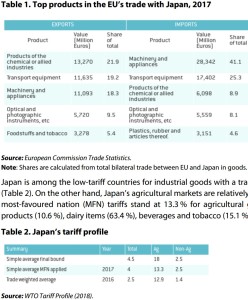
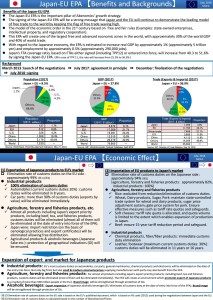
Japan-EU EPA 【Benefits and Backgrounds】(PDF; 07/2018) | MOFA Japan You can also check out the first one of the below pictures.
Japan-EU Strategic Partnership Agreement (SPA) (07/17/2018) | MOFA Japan
2018 Japan-EU Summit: Signing Ceremony Of EPA And SPA (YouTube)

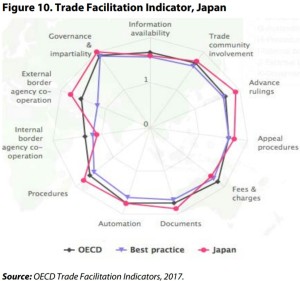
The EU – Japan Economic Partnership Agreement (w PDF; 09/2018) | Policy Department for External Relations @ European Parliament (@Bruegel) You can also check out all the below pictures but the first one.
PDF p11 Within the EU-28, in 2017 the top goods exporters to Japan were Germany, Italy, the UK and France, respectively accounting for 32.87 %, 10.82 %, 10.67 % and 10.53 % of the EU’s EUR 60.66 billion of commodity exports to Japan in 2017. Germany, Italy, the UK and France were also the top four importers of Japanese goods, with respective shares of 23.28 %, 16.48 %, 14.37 % and 12.76 % of the EUR 68.89 billion worth of EU commodity imports from Japan in 2017.
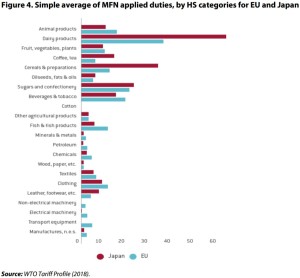
Japan is among the low-tariff countries for industrial goods with a trade-weighted tariff average of 1.4 % (Table 2). On the other hand, Japan’s agricultural markets are relatively protected. Simple average applied most-favoured nation (MFN) tariffs stand at 13.3 % for agricultural goods, with high tariffs on animal products (10.6 %), dairy items (63.4 %), beverages and tobacco (15.1 %).
Figure 4 depicts the EU’s and Japan’s tariffs by harmonised system (HS) product categories. In terms of the average applied MFN tariffs, we note that Japanese tariffs are low across numerous sectors such as electrical machinery (0.1 %), transport equipment (0) and manufactures not elsewhere specified (n.e.s) (1.2 %). Prominent exceptions are clothing (9 %), leather and footwear (7.7 %).
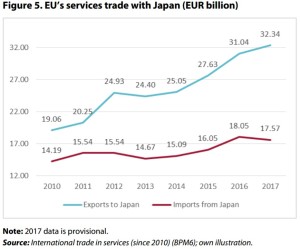
p12 The dominant sectors in the EU’s total service exports to Japan in 2016 were financial services (23.53 %), telecommunications (14.5 %) and transport (13.97 %).
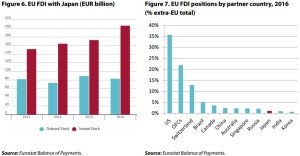
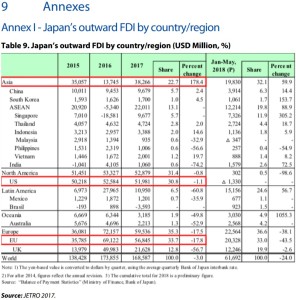
p13 Japan accounted for only 1.1 % of the total extra-EU FDI in 2016 (Figure 7). By comparison, EU investments in the US and Canada are much higher, representing 38 % and 3.7 % of total extra-EU FDI. Japanese investment in the EU stood at USD 56.8 billion, 33.7 % of its total FDI stock abroad in 2017. However, it should be noted that a substantial share, approximately 38 %, of Japan’s FDI stock in the EU is in the UK …
p15 A low score (0.05) in OECD’s FDI Regulatory Restrictiveness Index (2017), which measures statutory limitations on FDI, is indicative of the relative openness of the Japanese economy to foreign investors, as the OECD average is 0.07. On the other hand, the US (0.09), Canada (0.162) and China (0.316) are all relatively more restrictive as destinations for FDI. Except for a few countries in Europe (Austria, Poland and Sweden), all EU Member States are more open to FDI than Japan, with Luxembourg, Portugal and Slovenia being the least restrictive.
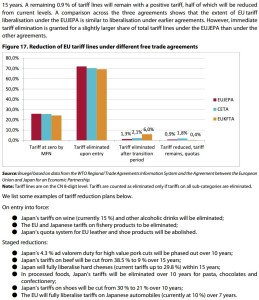
p17 Tariffs Agricultural goods. … significant reductions in customs duties for the EU’s major food exports to Japan such as pork (e.g. 4.3 % to 0 over 10 years for high value cuts), wine (15 % to 0 % on entry into force), beef (38.5 % to 9 % over 15 years), pasta and chocolates (complete tariff liberalisation in 10 years). For cheeses, the EUJEPA will deliver complete liberalisation for hard cheeses and provide tariff rate quotas (TRQs) with duty free access for fresh, processed and soft cheeses.
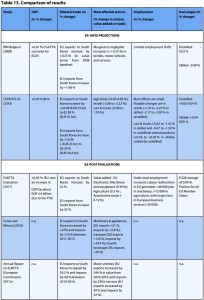
Industrial goods. In the agri-goods industry, South Korea was traditionally protectionist with a trade-weighted tariff of 49 % in the pre-FTA period. By 2014 however, these had been reduced on a preferential basis for EU goods to 28 %. The EU also liberalised its agricultural markets for South Korea by reducing trade-weighted tariffs from 11 % to 3 %.
Non-Tariff Barriers … Commission’s Impact Assessment Report (CIAR) in 2012 (European Commission, 2012). Japan is aligning itself with international standards on medical devices (Quality Management Systems), textile labelling (ISO international care labelling), motor vehicles (UNECE international vehicle regulations) and pharmaceuticals (ICH).
p18 Services The EUJEPA seeks to promote bilateral trade in a broad range of services but does not require governments to deregulate or privatise the provision of public services such as healthcare, water supply and education. … In telecommunications, the agreement covers issues such as mobile roaming, number portability and confidentiality of users’ traffic data. In financial services, the agreement calls for deeper regulatory cooperation and establishes a Joint Financial Regulatory Forum for this purpose. In e-commerce, the parties commit to keep electronic transmissions duty-free, recognise the legal validity of electronic contracts and signatures and may not require source codes to be transferred or accessed. In postal and courier services, the EUJEPA will attempt to build a level-playing field for EU suppliers and their main competitors such as Japan Post.
p21 Japan is one of the least restrictive economies in the world according to ECIPE’s Digital Trade Restrictiveness Index Report …
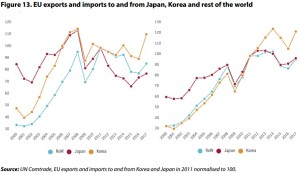
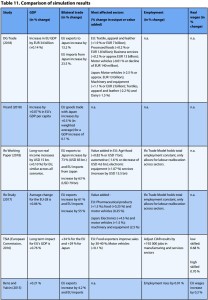
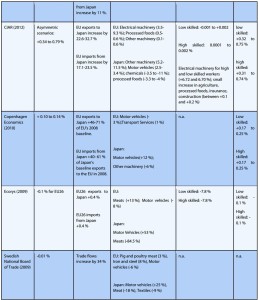
pp30-33 Bilateral trade There is substantial variation in the anticipated trade response. DG Trade (2018) found that the EUJEPA would lead to an increase of +13.2 % (EUR 13 billion) increase in EU exports to Japan. EU exports to Japan would rise by 22.6-32.7 % in the CIAR (2012) simulations. A much stronger export response for the EU is found in Ifo 2017 (61 %) and Ifo 2018 (73 %).
On the import side, DG Trade (2018) reports a 23.5 % (EUR 22 billion) increase in EU imports from Japan. This result is similar to that of CIAR (2012) which predicted increases in EU import purchases from Japan in the range of 17.1-23.5 %. In contrast, Ifo (2017) and Ifo (2018) simulations lead to increases in EU imports from Japan of 55 % and 63 %, respectively.
Sectoral value added All EUJEPA studies report a positive impact on value added in agri-food industries e.g.+0.82 % according to Ifo 2018, +0.2 % increase in output for processed foods in DG Trade (2018), 0.5-0.6 % for processed foods in the CIAR (2012) and +13 % for meats in Ecorys (2009). For automobiles, projections of value added are model-dependent.
By 2035, Japan’s car exports to EU increase by nearly 51 % in this study. Because of significant NTB reductions by Japan in motors, the EU also increases its exports to Japan following the EUJEPA (+11.5 %).
Textiles, apparel and leather products benefit from the agreement as well. The industry is expected to increase its output by 2 % (EUR 7 billion) in the EU, with exports to Japan rising by 220 % (EUR 5 billion) in DG Trade (2018).
Impact of Brexit Brexit has a greater impact on Japan, as it reduces the economic benefits from EUJEPA by 14 % (EUR 1 billion) and 20 % in Ifo 2017 and Ifo 2018, respectively. This is the result of a smaller market size for Japanese companies following Brexit.
Impact of CPTPP-11 Ratification of the CPTPP-11 agreement between Japan and 10 Pacific countries may also affect gains from EUJEPA. This scenario is evaluated in Ifo 2018. Simulation results reveal that the conclusion of the agreement leads to slightly smaller positive gains for the EU and slightly higher real-income gains for Japan (from 0.308 % to 0.314 %) compared to the simple baseline scenario. CPTPP-11 is expected to reduce Japan’s costs of sourcing inputs from the Asia-Pacific, improving its competitiveness and trade with the EU.
pp44-45 1/Investment liberalisation and promotion ISDS is the mechanism preferred by Japan, one that it has also supported under the CPTPP-11. In the investment negotiations held during July 2018, chief negotiators from the EU and Japan acknowledged the convergence of positions on investment protection standards but not on investor-state dispute settlement.
2/US investigation into auto imports … In March 2018, the US Department of Commerce initiated a National Security Investigation into the import of automobiles and auto parts into the US. This investigation is motivated by Section 232 of US’s Trade Expansion Act of 1962 and will examine whether declining American domestic production in the automobile sector poses a threat to its national security by weakening the internal economy and reducing domestic research on advanced technologies. Given the deep value chains in the auto industry, EU and Japanese car producers would be significantly harmed if the investigation leads to an increase in duties on foreign vehicles entering the US market.
On 25 July 2018, European Commission President Jean-Claude Juncker and US President Donald Trump announced plans to hold off on any new unilateral tariffs against each other as bilateral negotiations proceed on liberalising non-auto industrial goods, increasing EU imports of US soybeans and liquified natural gas (LNG), addressing WTO issues, reassessing US steel and aluminium tariffs and EU’s imposition of retaliatory tariffs on US goods. The EU will therefore be shielded from the conclusions of the US auto investigations, unless ongoing negotiations are halted by either party.
4/Tariff rate quotas (TRQs) … In the EUJEPA, Japan provides TRQs for agri-foods such as whey products, malt, potato starch, fresh and processed cheeses. …
5/Japan’s future trade ties with the UK … during the transition period (March 2019 to end of 2020). The exact terms of EUJEPA would hence be applicable to the UK over this period. Their implementation will be crucial for Japan’s car manufacturers that collectively produce 800 000 vehicles in the UK, accounting for 50 % of the UK’s total annual production …

In Focus EU-Japan ECONOMIC PARTNERSHIP AGREEMENT | European Commission
EU-Japan Economic Partnership Agreement: texts of the agreement | European Commission
EU-Japan: A Partnership of Renewed Importance (w PDF) | Cristina de Esperanza Picardo @eucentresg
New EU-Japan economic, strategic partnership may work better than past efforts (07/19/2018) | Bastian Harth @ Asia Times
… The SPA lays out the first-ever framework between the EU and Japan for cooperation and dialogue across various bilateral, regional, and multilateral issues such as cybercrime, disaster management, energy security, climate change, and aging populations. It also calls on both sides to synergize on promoting peace, stability, and international prosperity, and to recede from a sectoral and segmented approach to a comprehensive and legally binding cooperation framework. …
Especially, cybersecurity is of enormous importance for Japan, given the upcoming 2020 Tokyo Olympics. Millions of cyberattacks are predicted, and despite the country’s remarkable public safety… The topic is of such importance that Japan is even going to join the NATO Cooperative Cyber Defense Centre of Excellence in Tallinn. …

Brexit, a Catalyst for Closer EU-Japan Relations? (PDF) | Irina Angelescu
… Consequently, there is an implicit understanding from the Japanese side that the UK government “owes” special attention to Japanese interests, and should keep those interests in mind when negotiating Brexit. The former UK Ambassador to Japan, David Warren, indicated that some of his Japanese counterparts share a sense of “betrayal,” …
…three Japanese car manufacturers (Honda, Nissan and Toyota) now make almost half of the 1.67 million cars produced in the UK. …
… GlaxoSmithKline Plc estimates that, in the next two-three years, it could incur costs as high as 70 million pounds ($98 million) of Brexit-related costs. Similarly, Johnson & Johnson estimated that it could face as many as 50,000 additional tests in the amount of 1 million pounds if there will be no post-Brexit mutual recognition of testing between the EU and the UK. AstroZeneca and MerkKGaA raised similar concerns. …
… Mitsubishi Bank UFJ picked Amsterdam as its base for EU securities operations, while Nomura Holdings, Daiwa Securities and Sumitomo Matsui Financial Group said they would move to Frankfurt. …
… Decisions such as that of Unilever – the UK’s third largest company to consolidate its HQ in the Netherlands and abandon the separate London HQ is just one recent example that has caused more unease among third parties about the outcome of Brexit. …
The Japanese position has remained consistent about its preferences for Brexit from the very beginning: no Brexit or the “softest” form of Brexit, with unhindered access to the European Single Market – preferably preceded by a very long transition period that would allow Japanese businesses to adapt to changes. …
… In particular, joint training and cooperation to address newer threats like cybersecurity or disinformation campaigns conducted by countries like Russia and China could prove to be mutually beneficial. In principle, the U.S. should also welcome the closer economic ties between the EU and Japan as a means to promote free trade worldwide. At the same time, the EU-Japan data protection agreement and certain provisions in the EU-Japan EPA such as Geographic Indicators (GIs) for agricultural products could negatively affect U.S. interests. …
EU-Japan partnership agreements herald new era of closer cooperation (29/01/2018) | Irina Angelescu @ European Council on Foreign Relations

The EU-Japan Strategic Partnership Agreement (SPA): Good but Good Enough? (16/10/2018) | Axel Berkofsky @ ISPI
The EU-Japan Strategic Partnership Agreement (SPA) – Responding to the Crisis of the Liberal World Order (PDF; 12/2017) | Axel Berkofsky @ University of Pavia, Italy & Istituto per gli Studi di Politica Internazionale (ISPI) (@ Bertelsmann Stiftung) You can check out Table 1 and Figure 2 (in this PDF).
The EU-Japan EPA/SPA and the ‘Abe Doctrine’: Reinforcing Norms Globally, Changing them Domestically (PDF; 07/2018) | Edward Danks @ European Institute for Asian Studies
JAPAN-EU COOPERATION IN THE ERA OF INTERNATIONAL ORDER TRANSFORMATION: IN SEARCH OF A STABLE WORLD SYSTEM (w PDFs; 28/11/2017) | INSTITUTE FOR EUROPEAN STUDIES
EU-Japan Strategic Partnership Agreement (w PDFs) | Lords Select Committee, UK Parliament
EU-Japan Security Cooperation: trends and prospects (PDF; 07/03/2018) | The Royal Institute of International Affairs of Belgium & the University of Essex
EU-JAPAN – READY FOR A NEW STAGE IN RELATIONS? (PDF; Spring 2014) | Friends of Europe
The EU-Japan Strategic Partnership Agreement (SPA) – A Framework To Promote Shared Values [International Agreements In Progress] (12/10/2018) | Enrico D’Ambrogio @ European Parliamentary Research
Largest Bilateral Free Trade Agreement: Japan, EU Conclude Bilateral Economic Partnership Agreement (18/07/2018) | Ankit Panda @ The Diplomat

〔Charts, Tables, etc.〕
EUJEPA MOFAjapan BenefitsTopProducts EU-JapanAve MFNdutiesEU servicesTrade wJapanEU FDIJapan outwardFDITradeFacilitationIndicator JapanEU ExImReduction EUtariffsComparison simulations Tab11Comparison simulations Tab11-2Comparison results Tab13