U.K. イギリス Vol.20(ウェールズ Wales)

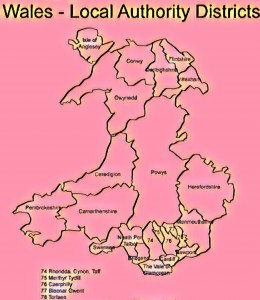
Wales LocalAuthorityDistricts
加工元地図及び加工後のこの地図に England の Herefordshire が入ってしまっていますが、当然間違いです。公開及びツイートの後で気付きました。
While the original white map and this retouched one of Wales include Herefordshire of England, it is a matter of course that it is wrong. I found this mistake after I published this post and related tweet.

取り急ぎ、以下貼っておきます。

UK Vol.134 (Wales Vol.8 – Merthyr Tydfil, Caerphilly, Blaenau Gwent, Torfaen, Newport, Monmouthshire)

UK Vol.133 (Wales Vol.7 – Swansea, Neath Port Talbot, Bridgend, Rhondda Cynon Taf, Vale of Glamorgan, Cardiff)

UK Vol.97 (Wales Vol.5 – Pembrokeshire, Carmarthenshire)

UK Vol.83 (Wales Vol.4 – Powys, Ceredigion)

UK Vol.78 (Wales Vol.3 – Isle of Anglesey, Conwy, Gwynedd)

UK Vol.74 (Wales Vol.2 – Flintshire, Wrexham, Denbighshire)

UK Vol.107 (Wales Vol.6)
UK Vol.4 (Wales Vol.1)

「ウェールズ」でツイッター検索すると出て来るものの一部を、以下貼っておきます。
https://twitter.com/rugbyworldcupjp/status/1113278725393485824
https://twitter.com/rugbyworldcupjp/status/1113004445313318913
https://twitter.com/rugbyworldcupjp/status/1107929709059301376
https://twitter.com/rugbyworldcupjp/status/1107567756898033664
https://twitter.com/rugbyworldcupjp/status/1100599687843729409
https://twitter.com/rugbyworldcupjp/status/1098881509031727104
https://twitter.com/rugbyworldcupjp/status/1068437391298326529


https://twitter.com/rugbyfoot/status/1115831019721064449


https://twitter.com/rugbyfoot/status/1082921676864667648


https://twitter.com/RugbyMBS/status/1108953191524098050
https://twitter.com/DAZN_JPN/status/1102335609035726848
https://twitter.com/DAZN_JPN/status/1091918381526249493


https://twitter.com/UKinJapan/status/1110058733021859840
https://twitter.com/UKinJapan/status/1101392778376802304
https://twitter.com/UKinJapan/status/1101346409293312000
https://twitter.com/UKinJapan/status/1097443185012416512
https://twitter.com/britculturejp/status/1109317953902698499


https://twitter.com/k_h3021/status/1094967231539081216

U.K. イギリス Vol.19(スコットランド Scotland)

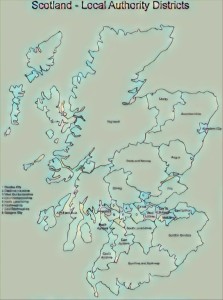
UK Scotland1 LocalAuthorityDistricts1

取り急ぎ以下貼っておきます。
Subdivisions in Eurostat NUTS 地方
Eastern = Angus and Dundee; Clackmannanshire and Fife; East Lothian and Midlothian; Scottish Borders; Edinburgh; Falkirk; Perth and Kinross, and Stirling; West Lothian
South Western = East Dunbartonshire, West Dunbartonshire, and Helensburgh and Lomond; Dumfries and Galloway; East and North Ayrshire mainland; Glasgow; Inverclyde, East Renfrewshire, and Renfrewshire; North Lanarkshire; South Ayrshire; South Lanarkshire
North Eastern = Aberdeen and Aberdeenshire
Highlands and Islands = Caithness and Sutherland, and Ross and Cromarty; Inverness, Nairn, Moray, and Badenoch and Strathspey; Lochaber, Skye and Lochalsh, Arran and Cumbrae, and Argyll and Bute (except Helensburgh and Lomond); Eilean Siar (Western Isles); Orkney Islands; Shetland Islands

UK Vol.98 (Scotland Vol.22 – North Eastern)

UK Vol.85 (Scotland Vol.21 – Eastern Vol.3)
UK Vol.80 (Scotland Vol.20 – Eastern Vol.2)
UK Vol.76 (Scotland Vol.19 – Eastern Vol.1)

UK Vol.72 (Scotland Vol.18 – South Western Vol.2)
UK Vol.70 (Scotland Vol.17 – South Western Vol.1)

UK Vol.10 (Scotland Vol.1 – Highlands)

Council areas 一部個別地域
UK Vol.23 (Scotland Vol.14 – Dumfries & Galloway economy)
UK Vol.22 (Scotland Vol.13 – Renfrewshire economy)
UK Vol.21 (Scotland Vol.12 – Orkney Islands economy)
UK Vol.20 (Scotland Vol.11 – Shetland Islands economy)
UK Vol.19 (Scotland Vol.10 – Glasgow economy)
UK Vol.18 (Scotland Vol.9 – East Dunbartonshire economy)
UK Vol.17 (Scotland Vol.8 – Clackmannanshire economy)
UK Vol.16 (Scotland Vol.7 – West Lothian economy)
UK Vol.15 (Scotland Vol.6 – Angus economy)
UK Vol.14 (Scotland Vol.5 – Kincardineshire economy)
UK Vol.13 (Scotland Vol.4 – Aberdeenshire economy)
UK Vol.12 (Scotland Vol.3 – Invernessshire economy)
UK Vol.11 (Scotland Vol.2 – Ross & Cromarty economy)

「スコットランド」でツイッター検索すると出て来るものの一部を、以下貼っておきます。

U.K. イギリス Vol.18(北アイルランド Northern Ireland)

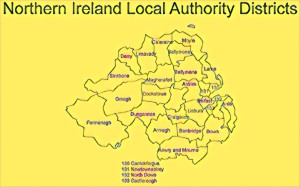
UK NorthernIreland LAdistrictsUK NorthernIreland counties
All the below links are in English.

取り急ぎ以下貼っておきます。

Local Authority Districts
Antrim and Newtownabbey; Belfast
UK Vol.99 (Northern Ireland Vol.4)

Newry, Mourne and Down; Ards and North Down; Lisburn and Castlereagh
UK Vol.82 (Northern Ireland Vol.3)

Mid and East Antrim (Carrickfergus, Larne, Ballymena); Mid Ulster (Magherafelt, Cookstown, Dungannon); Armagh, Banbridge and Craigavon
UK Vol.77 (Northern Ireland Vol.2)

Fermanagh and Omagh; Derry and Strabane; Causeway Coast and Glens
UK Vol.73 (Northern Ireland Vol.1)

その他 Miscellaneous
Good Friday (& Agreement)

UK Vol.91 (Post-EUref #Brexit Vol.20: 2017 General Election – Plaid Cymru, Democratic Unionist Party, Sinn Féin)

UK Vol.59 (Religion and the patterns of conflict in Northern Ireland)

UK Vol.52 (Concern over Brexit’s impact on political landscape in Northern Ireland)

UK Vol.5 (Northern Ireland)

なお、今、ツイッターで日本語で「北アイルランド」と入れて検索したら、以下のようなものが出て来ましたので、取り急ぎ情報として貼っておきます。
個人としてはニュアンスやトーンに必ずしも共感しない等のものが含まれる可能性があります旨、常々ご留意頂ければ幸甚です。


https://twitter.com/euryugaku/status/1113569365096423424

Ireland アイルランド Vol.7(州 counties)

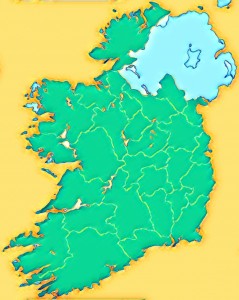
Ireland GreenYellow

All the below links are in English.

取り急ぎ、標記につき今までにまとめたものを以下貼っておきます。

Ireland Vol.43 (Leinster Vol.10 – City of Dublin Vol.3)

Ireland Vol.42 (Leinster Vol.9 – City of Dublin Vol.2)

Ireland Vol.41 (Leinster Vol.8 – City of Dublin Vol.1)

Ireland Vol.36 (Leinster Vol.7 – Fingal)

Ireland Vol.35 (Leinster Vol.6 – South Dublin)

Ireland Vol.34 (Leinster Vol.5 – Dún Laoghaire – Rathdown)

Ireland Vol.33 (Leinster Vol.4 – Wicklow, Kildare)

Ireland Vol.32 (Leinster Vol.3 – Meath, Louth)

Ireland Vol.31 (Leinster Vol.2 – Laois, Offaly, Westmeath, Longford)

Ireland Vol.30 (Leinster Vol.1 – Kilkenny, Carlow, Wexford)

Ireland Vol.22 (Munster Vol.3 – Tipperary, Waterford)

Ireland Vol.21 (Munster Vol.2 – Kerry, Cork)

Ireland Vol.20 (Munster Vol.1 – Clare, Limerick; #StPatricksDay)

Ireland Vol.19 (Connacht Vol.2 – Mayo, Galway)

Ireland Vol.18 (Connacht Vol.1 – Leitrim, Sligo, Roscommon)

Ireland Vol.17 (Ulster – Donegal, Cavan, Monaghan)

Pinned tweets, etc. 固定ツイート等

アイルランドの政治・行政・企業・地方・大学: 英文脚注15000以上―アイルランド・米国・英国・欧州・日本企業情報を含む Kindle版 中港拓 (著)

#FoodexJapan2019 non-Japanese companies #フーデックスジャパン2019 外国企業(於:幕張メッセ Makuhari Messe)
https://twitter.com/WSjp_insight/status/1115147825342345217
U.K. イギリス Vol.18(北アイルランド Northern Ireland)
U.K. イギリス Vol.19(スコットランド Scotland)
U.K. イギリス Vol.20(ウェールズ Wales)

U.K. イギリス Vol.16(Brexit Vol.13:報道等において正面から触れられていないブレグジット三点 3 points concerning Brexit which have not been confronted in the media etc.)
U.K. Vol.17(Brexit Vol.14: 3 points concerning Brexit which have not been confronted in the media etc. – especially outside the United Kingdom and the Republic of Ireland)


EU-Japan Economic Partnership Agreement 日EU経済連携協定(EUJEPA)Vol.2


EUJEPA Vol.3
TPP Vol.4
TPP Vol.5
TPP Vol.6


ツイート:サイバーセキュリティ


SNSは複雑単純あるにしてもどれでも使い続けないと正直よく分からないものであると認識していますが、当方が唯一使い続けているツイッターの良さは
1.設定が全体に自由かつ簡単であり、また、それゆえもあり拡散力に優れてもいる
2.そのため、難しい話を内容とするディスカッション、コンテンツマーケティング、キュレーションに適している。
こういう良さを備えるSNSは、今後も出て来ないように感じます。
そもそも、情報が有り過ぎて困る今の時代には、ある意味キュレーション無くして物事の正確な理解はできません。
この意味では、キュレーション等のためのツイッターも、その存在無くして今の時代を語れないとも言い得ます。
フォロワー数やリツイート数・ライク数よりも、コンテンツの質が重要とも言えます。

https://twitter.com/WSjp_insight/status/1106487409204555776
Honestly, we have understood that it is difficult to understand how to use social network services, if we don’t keep using some specific ones, regardless of being complicated or simple. The strengths of Twitter, which we have kept using as our single tool, would be:
1. in general, we can set it freely and easily, and so forth as well, it is good at spreading stories on the Internet;
2. therefore it is suitable to discussions, content marketing, curation, etc. on difficult topics or contents.
It seems that there will not be such strong services other than Twitter.
Today, when there is too much information, in a sense, it is impossible to accurately understand news without curation.
In this sense, it would be impossible to talk about current era without presense of Twitter, which is suitable to curation, etc.
We can say that the quality of contents is far more important than the numbers of followers, retweets, likes, etc.

ご参考:
1.(無料で使用しているので思うような表示にはなっておりませんが)一応、https://9223.teacup.com/ireland_corps/bbs という(概ね日本語 Mostly in Japanese の)デジタルサイネージ digital signage があります。アイルランド関連・電子書籍関連に可能な限り絞って貼って行こうと考えています。
2.https://www.goodreads.com/world_solutions (in English)
これは引き続き、若干趣味的に試行錯誤の最中です。フィクション作品愛好者が圧倒的に多い、更新後の内容が表れるのが半日くらい後である、などの特徴があると言えそうです。
3.2019年4月16日、書籍Facebookページを公開停止といたしました。今までご覧頂いた等の方々、誠にありがとうございました。引き続き、本ウェブサイトやツイッター等をご覧頂ければ幸甚です。
On April 16, 2019, we stopped publishing the eBook-related Facebook page. Thank you so much for having visited that page, etc. We would be very pleased if you continue visiting this website, Twitter accounts, the Teacup digital signage, etc.

#FoodexJapan2019 non-Japanese companies #フーデックスジャパン2019 外国企業(於:幕張メッセ Makuhari Messe)

先週行われた標記に幸運にもご招待頂き、4日間のうち最初の2日間行って来ました。
取り急ぎ下記(順不同)のとおり、名刺交換し(濃淡はありますがお話し)た外国企業の約半数を貼っておきます。企業名部分がハイパーリンクになっていますので、押して頂くと各企業ウェブサイトに飛びます。
私は通常、名刺交換・会話したのみでは固有名詞を挙げませんが、
日本でのビジネスを後押し申しあげたい(そして日本企業の在外ビジネスもどんどん活発化する必要がある)という想い(及び客観情勢)
により今回はこのようにします。
なお、ここに挙げた企業全て宛てに、こういう宣伝を行う旨、事前にメールを送ってあります。
I was lucky enough to be invited to Foodex Japan 2019, and visited many booths at Makuhari Messe on its first and second days.
As below (no particular order), I pasted names and hyperlinks of about half of the companies with which I exchanged my name cards (and talked with more rich content or less). If you push the names, you can go to the companies’ websites.
Although I usually don’t publicize specific names when I just exchanged my name cards and had conversations, this time I am doing it because I would like to boost foreign companies’ business in Japan (and Japanese companies also need to expand business in foreign countries more).
Please note that I let all the below companies know in advance.
March 13, 2019
Taku NAKAMINATO 中港 拓

Finland フィンランド / Cheese チーズ各種  Finnish Cheese Company Ltd
The Netherlands オランダ / Gouda cheese ゴーダチーズ類  Vergeer Holland
Bulgaria ブルガリア / Cheese, Butter チーズ各種及びバター  Germa Food Stuff Trading LLC
Greece ギリシャ / Feta cheese, Yoghurt, etc. フェタチーズ、ヨーグルト等  ROUSSAS
Greece ギリシャ / Yogurt, Feta cheese, etc. ヨーグルト、フェタチーズ等  Mevgal S.A.
Denmark デンマーク / Eggs 鶏卵  Danaeg Products A/S
Australia オーストラリア / Kangaroo and wild game meat カンガルー及び獣肉  Macro Group Australia Pty Ltd.
Finland フィンランド / Pork 豚肉類  Snellmanin Lihanjalostus Oy (フィンランド語)
Canada カナダ / Processed pork 豚肉加工品  Siwin Foods Ltd.
Australia オーストラリア / Dumplings, etc. 東欧風餃子等  From Granny
USA アメリカ / Pecan ペカン  Hudson Pecan Company, Inc.
Mexico メキシコ / Canned peppers, salsas, etc. 缶詰トウガラシ・大豆ソース等  La Morena
Indonesia インドネシア / Seasoning 調味料  PT RODAMAS INTI INTERNASIONAL
Belgium ベルギー / Salt 塩  Zoutman
Italy イタリア / Canned tuna, etc. ツナ缶詰等  Macaluso
Italy イタリア / Preserved tomatoes 保存トマト  Finagricola Soc.Coop.
Germany ドイツ / Health and functional confectionary ヘルスケア菓子(サプリメント等)  sanotact GmbH
Italy イタリア / Truffle トリュフ  Selektia Italia s.r.l
Italy イタリア / Pasta パスタ  Pasta Zara S.p.A.
Ukraine ウクライナ / Garlic ニンニク  Agro Patriot
Greece ギリシャ / Green pitted olives, etc. オリーブ加工品等  EL MAR OLIVES LTD
Australia オーストラリア / Olive oil オリーブオイル  Pendleton Olive Estate
Australia オーストラリア / Olive oil オリーブオイル  OLEAPAK PTY.LTD
Greece ギリシャ / Olive oil オリーブオイル  ELEON – Soya Hellas S.A.
UK イギリス / Nuts ナッツ類  Snack Factory Limited
India インド / Cashews カシューナッツ  Prasanthi Cashew Company
Thailand タイ / Snack スナック菓子  Kanom Thaipattana Co., Ltd.
Italy イタリア / Snack スナック菓子  Nutkao
Belgium ベルギー / Biscuits ビスケット  Noble Food Group
Canada カナダ / Banana chips, etc. バナナチップス等スナック菓子  Oh! Naturals
Belgium ベルギー / Ice creams アイスクリーム  COLAC
Spain スペイン / Honey 蜂蜜  Alemany
Ukraine ウクライナ / Berry paste ベリーペースト  LiQberry
Turkey トルコ / Direct juice squeezing, etc. 各種フルーツジュース等色々  Goknur
Costa Rica コスタリカ / Pineapple chunks, etc. 冷凍パイナップル片等  Costa De Oro Internacional S.A.
Costa Rica コスタリカ / Pineapple chunks, etc. ドライバナナ等  Purejoy
UAE アラブ首長国連邦 / Date paste, Premium dates, etc. ナツメヤシペースト、高級ナツメヤシ等  Royal Palm
Tunisia チュニジア / Dried tomatoes, Dried pitted dates, etc. ドライトマト、ドライナツメヤシ等色々   Mila Business Group
Canada カナダ / Blueberries ブルーベリー  Westberry Farms
Austria オーストリア / Pomegranate juice, etc. ザクロジュース等  Rubin Garden Vertriebs GmbH
Poland ポーランド / Berry juice, etc. ベリージュース等  BIO JUICE
Ecuador エクアドル / Coffee コーヒー  El Cafe C.A.
Australia オーストラリア / Coffee コーヒー  Coffee MIO
Czech チェコ / Wine ワイン  Wine Of Czech
Italy イタリア / Wine ワイン  Cantina Frentana
Italy イタリア / Wine ワイン  CASCINA PIAN D’OR Az. Agricola di Barbero Valter
Italy イタリア / Wine ワイン  Cantine Sgarzi Luigi srl
Spain スペイン / Wine ワイン  WINES FROM GALICIA
Spain スペイン / Wine ワイン  Monte La Reina
Spain スペイン / Wine ワイン  VIRGEN DE LAS VINAS
Spain スペイン / Wine ワイン  Bodegas Jimenez-Vila Hnos

EUJEPA Vol.4 / TPP Vol.7 (チーズ、牛肉、シーフード、ワイン Cheese, Beef, Seafood, Wine)

取り急ぎ標記につき以下貼っておきます。

English
Cheese
Beef
Seafood
Wine

日本語


https://twitter.com/txbiz_ondemand/status/1095975961810526208


https://twitter.com/EmbEspJapon/status/1019149054498910208
https://twitter.com/EUinJapan/status/1062186435736936448


https://twitter.com/franceiine/status/1091127440242442240

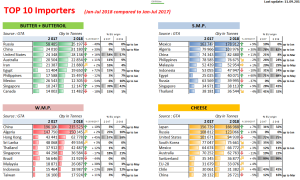
cf. Cheese, etc., Top 10 Importers
EUJEPA-TPP cheese top-10-importers

U.K. Vol.17(Brexit Vol.14: 3 points concerning Brexit which have not been confronted in the media etc. – especially outside the United Kingdom and the Republic of Ireland)

Now we have only one month left to March 29, 2019, the day of Brexit. Whenever possible since the UK referendum in 2016, I have checked out news articles, professional reports. government’s remarks, etc. in English and Japanese. I am listing and explaining the three topics which have seemingly not been confronted in the media, etc., as below.

I. Leaving the European Union Customs Union and Avoiding the return of a Hard Border between Northern Ireland and the Republic of Ireland are incompatible.
I have gotten an impression from the media, etc.: in the U.K., Leavers and Remainers have respectively been stick to their own convictions since political activities before the referendum; and agreements between the two factions and those between the EU and UK by the deadline seem a steep path.
In the first half of last year, I felt such steepness is due to the Northern-Southern border. And I have come to feel so stronger, last autumn when there arose much news about the Brexit backstop – a safety net in order that the NI and the ROI will maintain the current open border, under the 1998 Good Friday agreement which decided not to make physical facilities on the border, in case no formal deal between the EU and the UK can be reached on trade and security arrangements by the end of transition period, i.e. the end of the year 2020.
In English there is much news articles plainly explaining the border question, and not a few ones whose precondition is the above incompatibility. However, there seems no article which confronts the incompatibility itself. In Japanese, there seems no such news articles other than the one written by a senior researcher of a Japanese think tank who I do not know in person.
That article says the entire Brexit necessitates the hard border – such a tight border control that Japan has done as a distinct economic area; and you need to give up the entire Brexit if you maintain the current open border, which means you need to stay in the EU customs union as you belong to the same economic area as the EU. I agree to it. I have an overall impression that concerned people have actually continued to find some compromise plan because it would have been all for nothing if they had said this clearly in public. However, eventually, nothing comes from nothing.
The incompatibility eventually leads just to “some people choose one of the two”. There are options such as another referendum, a resolution of the House of Commons, a snap election, etc. In the first place, the referendum, one of the campaign promises in the 2015 general election, was conducted in 2016 and followed by a state of seemingly senseless chaos. So, the least unreasonable would be another referendum which confirms whether or not the result of the referendum in 2016 is UK citizens’ will in reality.
Fundamentally, not only referendum but also voting itself tends to be greatly affected by political winds, not decided by the content of the subject on which the judgement of the people was sought. And in 2016, Leave won by a very narrow margin, despite this result will turn over the status quo of the whole UK. If the result were Remain, i.e. maintaining the status quo, a very narrow margin would not matter. But the result was the turnover. What are convincing reasons to avoid another referendum under democracy, which ask people whether it is OK to really exit the EU on the basis of the narrow margin? I have not understood such reasons, while I saw “referendum should not be carried out twice because we had better preserve the credibility of the referendum”, etc. Most of UK citizens will be convinced, if another referendum confirms their judgement and a hard Brexit comes true.

II. The state of things in electoral districts of MPs who left the Labour or the Conservative parties.
As of 21 February, eight Members of Parliament have left the Labour, the largest opposition party, due to their dissatisfaction with its leader’s vague attitude toward Brexit, anti-Semitic attitude, etc. On the other hand, three MPs have left the Conservative, due to their dissatisfaction with the government’s catastrophic handling of Brexit. A total of these eleven members will not join the opposition Liberal Democrats, but form an independent group which aims to conduct another referendum (seemingly similar to my above thought). We can think in general that their actions are based on their concerns that they lament the UK as parliamentarians, or are related to circumstances of constituency to whom they owe many things.
The eight ex-Labours [district/county] are Coffey [Stockport/Greater Manchester], Smith [Penistone and Stocksbridge/South Yorkshire], Shuker [Luton South/Bedfordshire], Gapes [Ilford South/Greater London], Umunna [Streatham/Greater London], Leslie [Nottingham East/Nottinghamshire], Berger [Liverpool Wavertree/Merseyside], Ryan [Enfield North/Greater London]; the three ex-Conservatives Soubry [Broxtowe/Nottinghamshire], Allen [South Cambridgeshire/Cambridgeshire], Wollaston [Totnes/Devon].
According to a UK university’s research, for example, in Coffey’s Stockport, Leave-Remain difference were marginal, and Remainers increased in proportion to house prices. We can think that there are not a few people who have middle-price houses, voted Leave in 2016, but converted themselves to Remainers, while there are usually more middle-price house owners. Would this situational change urge the ex-Labour and ex-Conservative members to secede from the party and to try to conduct another referendum? When we see MPs’ voting behaviors at resolutions in the House of Commons, there must be cases in which it is useful to analyze not only house prices but the state of things in electoral districts.

III. The City of London does not prefer Jeremy Corbyn’s policies.
Although the ruling party achieved a great victory in the 2015 general election, it could not have been intrinsically strange if approval for the party had dropped significantly in the UK where regime changes by two largest parties have already taken roots, considering chaos which has continued so far and will continue. And the above attitude of the Labour leader seems to rather show his favor on soft Brexit.
However, in the media, etc., it has been said by and large that Corbyn’s Labour government with a strong left-wing flavor and its public policy such as re-nationalisation of public utilities and wealth tax are undesired, and are feared more than hard Brexit. The former would expand budget deficit and cause a sharp rise of inflation rate, which would lead to government bonds’ decrease in demand and long-term government bonds’ decrease in price. The latter would be an income tax hike towards people with over eighty thousand pounds, and would lead to the people’s escaping abroad and the UK’s revenue decline. The City is said to be on its guard against such policies. If I dare to say, its guard might not be off-base.
For example, concerning the re-nationalisation, we need to take the following into consideration: the UK government deficit-to-GDP ratio is not extremely bad (0.875 in 2017); and Tony Blair’s Labour government so positively expanded the PPP (public-private partnership) including the PFI (private finance initiative) that re-nationalisation, which means banks, equity investors and other private financiers being forced to take a haircut on their investments, is not wanted by the City. On the other hand, in many ages and countries, there have often been policy differences between two largest parties, which need to be tackled at any time taking considerable contents such as the above two into consideration.

It should be noted that immediate news coverage and possible analyses shortly after it are of course important. And I usually respect the importance to sort long processes, significant effects on international society, complicated and mysterious affairs of politics and economy, etc., at each turning point of major incidents. However, I picked up the above three points, on the assumption that I write about Brexit just this time – after countless news articles, researches, etc. were already published.

Taku Nakaminato, World Solutions LLC
24 February, 2019

The above is a provisional English translation of “Brexit Vol.13“.

P.S. I posted the above at around 5 pm (JST). Thank you for coming, many English readers.
Around 2 pm, 25 February Today I just added the following hyperlinks:
NOT JUST ANTISEMITISM: CORBYN’S BREXIT PROBLEM IS ALSO A DISASTER FOR JEWS
BRITISH PRIME MINISTER THERESA MAY COMMENTS ON LABOUR PARTY ATTRITION
Ian Austin quits Labour blaming Jeremy Corbyn’s leadership
Ian Austin says he couldn’t look Jewish father ‘in the eye’ if he remained in Labour party
Corbyn told: change course before it’s too late for Labour

France フランス Vol.1

Most of the below links (incl tweets) are in English.

取り急ぎ以下貼っておきます。

France Vol.3 (Finance)
France Vol.4 (Finance)
France Vol.5 (Brands)
France Vol.6 (Food)
France Vol.7 (Pharma/Health/Biotech/Food)
France Vol.8 (Energy/Utilities, Airplane/Train)
France Vol.9 (Digital/Telecommunications/Media)
France Vol.10 (Automobile)
France Vol.11 (United States)
France Vol.12 (U.S., Canada, U.K.)
France Vol.13 (Government, diplomacy, Ireland, technology, etc.)
France
https://twitter.com/WSjp_insight/status/1058629307210194944
France Vol.2 (2017 French Presidential Elections)
France Vol.1 (France regions, history, technology, et al.)

https://twitter.com/BFrance_Japan/status/1077757150947168257
https://twitter.com/ambafrancejp_jp/status/1078817878151856130


https://twitter.com/francediplo_EN/status/1077157080430186502


https://twitter.com/OECD/status/1078652120096743424


https://twitter.com/armeedeterre/status/978296480678207489
https://twitter.com/armeedeterre/status/973928625945956353
https://twitter.com/armeedeterre/status/947842288566308866


https://twitter.com/AgnesRunacher/status/1078328738335514626


https://twitter.com/Place_Beauvau/status/1075752233277505536


https://twitter.com/Min_Ecologie/status/1076071355706163205
https://twitter.com/franceintheus/status/1074390960682008576


https://twitter.com/CampusFrance/status/1052563186807988225
https://twitter.com/DWIH_Tokyo/status/1068791816982548480

TPP Vol.6

All the below links and excerpts (incl 5 pictures) are in English.

Comprehensive and Progressive Agreement for Trans-Pacific Partnership – National Interest Analysis @ NZ MFAT (PDF; 03/2018) You can check out the below pictures (Tables, etc.) as well.
p4 Table 1.1: Exports from New Zealand to new FTA partners
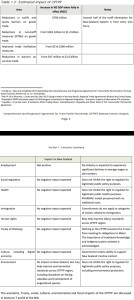
pp5-6 Table 1.2: Estimated impact of CPTPP
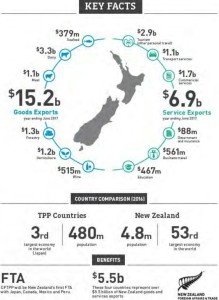
p8 KEY FACTS, etc.
p16 Japan is New Zealand’s fifth largest export market and it is a high value one for exporters. In the year to June 2017 two-way trade stood at NZ$7.9 billion. New Zealand exports to Japan were NZ$4.0 billion, accounting for 5.5 percent of our total exports. The trading relationship is highly complementary with New Zealand supplying food and industrial materials, such as wood and aluminium, and Japan exporting finished industrial goods and machinery to New Zealand. The CPTPP will help New Zealand agriculture exporters in particular overcome high MFN tariff rates into Japan. Japan is also New Zealand’s fifth largest source of foreign direct investment, with significant investments in the forestry sector. Services exports are another big part of our trading relationship, with Japan a top-five source of students and tourists.
p19 … There are already competitors that enjoy lower barriers to trade relative to New Zealand businesses in key CPTPP markets (e.g. Australia in Japan) and more will follow as other free trade agreements are realised (e.g. the EU-Japan FTA). …
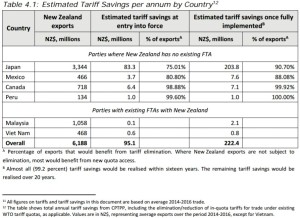
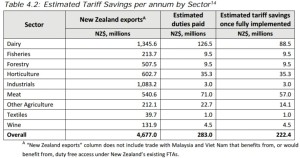
p22 Table 4.1: Estimated Tariff Savings per annum by Country
p23 Table 4.2: Estimated Tariff Savings per annum by Sector
pp23-24
• At entry into force (Year 1): tariffs eliminated on NZ$1.4 billion of New Zealand exports currently subject to tariffs, including many horticultural and forestry goods, a number of dairy products, some wine, many manufactured products, and much fish and seafood. Specific product examples include such items as: Japan (kiwifruit, squash); Canada (wine); Mexico (mussels, kiwifruit, milk albumin); and Peru (buttermilk powder). As a result, 79.8 percent of New Zealand exports to these new FTA markets would enter duty free on the day the CPTPP enters into force, with estimated tariff savings for New Zealand exporters of NZ$95.1 million.
• By the 5th year after entry into force (Year 6): tariffs eliminated on an additional NZ$111.2 million of New Zealand exports currently subject to tariffs, including: … Japan (hoki and other frozen fish, carrot juice, sausages and mandarins) … 2.4 percent of total current New Zealand exports to … 82.2 percent … Estimated total tariff savings in the fifth year after entry into force are NZ$148.1 million.
• By the 10th year after entry into force (Year 11): tariffs eliminated on an additional NZ$175.0 million … Japan (tongues, hides, bluefin tuna and apples) … 3.7 percent … 85.9 percent … NZ$186.9 million.
• By the 15th year after entry into force (Year 16): tariffs eliminated on an additional NZ$220.8 million … Japan (cheese, sawn wood and offal) … 4.7 percent … 90.6 percent … NZ$220.6 million.
• When fully phased in: tariffs eliminated on an additional NZ$71.9 million of New Zealand exports currently subject to tariffs. The total tariff savings from the CPTPP are estimated to be NZ$222.4 million per year at full implementation, not taking account of dynamic impacts.
pp24-25
• Tariff reductions: Tariffs on an additional NZ$207.1 million of goods exports would be significantly reduced, but not eliminated, allowing for improved market access. This includes beef exporters that would benefit from a 77 percent reduction in Japan’s tariff for beef. This tariff would be reduced from the current 38.5 percent duty to 9 percent over sixteen years, with an initial sharp cut at entry into force, to 27.5 percent. There will be a transitional volume-based safeguard applying to all CPTPP beef imports into Japan, set above current trade levels, with a growth rate. The safeguard will be abolished by Year 20 at the earliest. The new CPTPP safeguard would remove the potential for Japan’s WTO beef safeguard to be applied to New Zealand’s exports. That safeguard was exceeded in 2017 meaning that a higher ‘snap-back’ tariff of 50 percent is being applied to New Zealand exports through to 31 March 2018 placing New Zealand beef exporters at a significant disadvantage to other countries (e.g. Australia) that have an FTA with Japan. This outcome is the best outcome that Japan has agreed in a FTA to date, and would help re-establish a level playing field with Japan’s largest beef supplier, Australia, after the Japan-Australia Economic Partnership Agreement entered into force in early 2015.
Japan will also reduce the tariff for ice-cream by two-thirds, from 21 percent today to 7 percent over six years, opening up new export opportunities given the significantly reduced tariff.
p26 Table 4.3: Estimated Total Volume of CPTPP Quota Access available to New Zealand Exporters
By Year 10 of the CPTPP Agreement entering into force:
• Japan will provide 40,200 MT of predominately CPTPP-wide access, with 14,000 MT on priority products for New Zealand including butter and powders. Japan is also eliminating tariffs for most cheese over sixteen years.
p27 … For country-specific access into Japan, tariffs on WTO trade are eliminated over 21 years after entry into force, with an 80 percent reduction in the first 11 years. …
… Given the scale of some of the tariff benefits from CPTPP that would, in this scenario, accrue to New Zealand’s competitors inside CPTPP, but not New Zealand – e.g. Japan’s reduced beef tariffs, or tariff elimination on Japanese cheese tariffs – New Zealand exporters would likely lose significant market share to other CPTPP exporters if New Zealand were not part of CPTPP.
p53 … The CPTPP also builds on the opportunities New Zealand businesses secured under the WTO Agreement on Government Procurement (GPA), with some modest improvements to access in Canada, Japan and Singapore (e.g. additional entities and coverage of private-public-partnerships). …
pp86-87 Export restrictions – food security
In Article 2.26, Parties acknowledge that countries may temporarily apply an export prohibition or restriction on foodstuffs where there is risk of a critical shortage as set out in Article XI of the GATT 1994 and Article 2.1 of the Agreement on Agriculture. Further to this, the Parties agree that if a CPTPP country is a net exporter of a foodstuff and imposes an export prohibition or restriction on the foodstuff from another CPTPP country in these circumstances, it must notify all of the other Parties before the measure comes into force. Notification must include the reason that the measure was imposed or maintained, how the measure is consistent with the GATT and any alternative measures the Party considered imposing. Any Party that has a substantial interest as an importer of that foodstuff may request consultations with, or data relating to the critical food shortage from, the Party imposing or maintaining the measure.
Any measure that is notified under this procedure should ordinarily be removed within four to six months. If a Party is considering extending the measure for longer than this, further notification must be provided to the other CPTPP countries. Measures may only be continued for longer than twelve months if all other Parties that are net importers of the relevant foodstuff have been consulted. A measure must be discontinued immediately if the critical shortage, or threat of critical shortage, no longer exists.
These measures may not be applied to food purchased for non-commercial humanitarian measures.
p95 Global safeguards
pp105-107 Wine and Distilled Spirits Annex
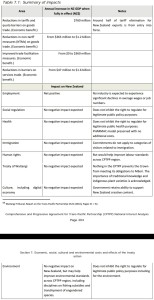
pp204-205 Table 7.1: Summary of impacts
p207 New Zealand exporters have direct experience of this kind of competitive displacement caused by being on the outside of preferential access enjoyed by competitors. For example:
• Since the entry into force of the Australia-Japan FTA, New Zealand beef exports to Japan have dropped by over 25 percent, with New Zealand exporters losing market share to their Australian competitors who are only beginning to enjoy tariff preferences under the FTA.
• Following the entry into force of the Korea-US FTA, US beef exports increased 25 percent. New Zealand exports declined by almost NZ$50 million. The US’ share of the Korean cheese import market has also grown from 41 percent to 74 percent.
• Until the entry in force of the New Zealand-Korea FTA, kiwifruit exporters paid a 45 percent tariff on kiwifruit. Their Chilean competitors enjoy duty-free access.
• Prior to the NAFTA agreement being signed by Canada, Mexico and the US in the 1990s, New Zealand was a significant supplier of dairy products to Mexico. Since Mexico eliminated tariffs for US dairy products, New Zealand’s share of Mexico’s cheese imports declined from 20 percent to 4 percent, and our share of milk powder imports from 25 percent to less than 10 percent.
ImpactEcon et al modelled the economic impact of the CPTPP by first estimating how New Zealand’s economy would be expected to develop as part of the global economy in the absence of CPTPP, and comparing this to the case where CPTPP liberalised trade in goods and services in four areas. The result of the CGE model takes account of the complicated adjustments that might take place in an economy following new trade flows and resource allocation. The four ways in which CPTPP was assumed to liberalise trade were:
• Reductions in tariffs and quota barriers on goods trade.
• Reductions in non-tariff measures on goods trade.
• Improved trade facilitation measures.
• Reductions in barriers on services trade.
pp207-211
pp221-225 8 The costs to New Zealand of compliance with the treaty
pp239-243 Overview of the suspensions

Latin American Perspectives on the Trans-Pacific Partnership (TPP) (PDF; 09/02/2016) | NEW ZEALAND CENTRE FOR LATIN AMERICAN STUDIES, School of Cultures, Languages and Linguistics, University of Auckland
“Is the TPP a mega-NAFTA that will devastate Mexico?” Daniel Villafuerte Solis, The Centre for Advanced Studies in Mexico and Central America (CESMECA)
The agro-food sector, the most hard-hit by NAFTA, could suffer a new beating under the TPP. To put this into context, let us remember some figures from the Bank of Mexico: in 2014, the Mexico had a trade deficit for agro-food and agro-industrial products of US $2.593 billion, an amount equivalent to 40% percent of the budget assigned that year to the Secretariat of Agriculture, Livestock, Rural Development, Fisheries and Food (SAGARPA).
The figures for imports by sector are frightening: between 2010 and 2014, imports of milk, diary, eggs and honey grew by 57.% totalling more than 2 billion dollars in 2014; meat and edible meat offal imports grew by 42.5% to $4.596 billion; cereals grew by 31.6% reaching $4.259 billion; and imports of legumes grew by 15.3%. Together, imports in these four sectors grew from $10.751 billion to $14.342 billion, an increase of 33.4%.
“What is the Trans-Pacific Partnership all about?” Alejandro Villamar, Mexican Action Network on Free Trade (RMALC)
To give just some examples of recent analyses of the potential impacts on food sovereignty, agriculture and health, the TPP would result in illegal contamination of foodstuffs by genetically modified organisms, and a new report questions the rules of food security and animal health in the TPP (http://goo.gl/SKKbqe).
“The TPP: Bad news for farmers and agriculture” Karen Hansen-Kuhn, Institute for Agriculture and Trade Policy
The bad news is that the TPP expands many of the worst features of NAFTA. Mexican farmers were devastated by the dramatic increase in corn exports from the U.S. under NAFTA. This didn’t help most U.S. farmers, who were pushed to expand exports to compensate for low prices and declining public support. It led to increasing corporate concentration in agricultural production, leaving farmers with fewer options of where to buy and sell their goods, and a decline in the number of family farmers in all three NAFTA countries. This unfair market will be deepened under TPP. …

No More Business-as-Usual: Where to Now for International Trade? (PDF; 07/2017) | David Hall @ Auckland University of Technology
Departmental Disclosure Statement – Trans-Pacific Partnership Agreement (CPTPP) Amendment Bill (PDF; 21/06/2018)
Economic Gains and Costs from the TPP – Review of Modelled Economic Impacts of the Trans Pacific Partnership (PDF; 2014) | Sustainablity Council of New Zealand
Submission of the Building and Wood Workers’ International (BWI) to the Foreign Affairs, Defence and Trade Committee (Parliament of New Zealand) regarding International treaty examination of the Comprehensive and Progressive Agreement for Trans-Pacific Partnership (PDF; 04/2018)
Personal values and support (or not) for the Trans-Pacific Partnership Agreement (PDF; 03/2018) | Jono Bannan, Simon Kemp and Zhe Chen @ University of Canterbury
The Benefits of Trade (PDF) | NZIER
The Trans-Pacific Partnership (TPP) (PDF; 09/2011) | NEW ZEALAND COLLEGE OF PUBLIC HEALTH MEDICINE

New Geopolitical Developments in the South Pacific: The Cases of Australia and New Zealand (PDF; 02/2018) | Dr. Anne-Marie Schleich @ ISPSW
TPP-11: Achieving Growth in a Time of Trade Uncertainty (27/08/2018) | Dr Luke Hurst @ Australian Institute of International Affairs
The TPP Investment Chapter & Investor State Arbitration in Asia & Oceania (PDF) | Dr Luke Nottage @ Sydney Law School
Can the Trans-Pacific Partnership multilateralise the ‘noodle bowl’of Asia-Pacific trade agreements? (PDF; 03/2016) | Jeffrey D. Wilson @ Perth USAsia Centre
THE TRANS-PACIFIC PARTNERSHIP: COPYRIGHT LAW, THE CREATIVE INDUSTRIES, AND INTERNET FREEDOM (PDF; 10/2016) | DR MATTHEW RIMMER (@ QUT) @ THE SENATE FOREIGN AFFAIRS, DEFENCE AND TRADE REFERENCES COMMITTEE
The TPP: Truths about Power Politics (PDF; 08/2017) | Malcolm Cook @ ISEAS – Yusof Ishak Institute

Trading Down: Unemployment, Inequality and Other Risks of the Trans-Pacific Partnership Agreement (PDF; 01/2016) | Jeronim Capaldo and Alex Izurieta with Jomo Kwame Sundaram @ GLOBAL DEVELOPMENT AND ENVIRONMENT INSTITUTE, Tufts University
Trade Implications of the Trans-Pacific Partnership for ASEAN and Other Asian Countries (PDF; 08/2013) | Alan V. Deardorff @ The University of Michigan
TPP Countries Sign New CPTPP Agreement without U.S. Participation (PDF; 03/09/2018) | Ian F. Fergusson & Brock R. Williams @ CRS Insight
The Trans-Pacific Partnership Negotiations and Issues for Congress (PDF; 08/21/2013) | Ian F. Fergusson, William H. Cooper, Remy Jurenas, Brock R. Williams @ Congressional Research Service (@ Cornell ILR)
Negotiations for a Trans-Pacific Partnership Agreement (PDF) | William Krist (Edited with an Introduction by Kent Hughes) @ Wilson Center
The Trans-Pacific Partnership: New Paradigm or Wolf in Sheep’s Clothing? (PDF; 01/01/2011) | Meredith Kolsky Lewis @ Boston College International & Comparative Law Review

TPP-11 Agree on List of Suspended Provisions (PDF; 11/13/2017) | Charles Akande @ Geneva Watch
The Trans-Pacific Partnership Deal (TPP): What Are the Economic Consequences for In- and Outsiders? (PDF; 12/2015) | Rahel Aichele and Gabriel Felbermayr @ CESifo Forum

NZmfat CPTPP NatlIntAnalysis Table1.2NZmfat CPTPP NatlIntAnalysis Key etc.NZmfat CPTPP NatlIntAnalysis Table4.1NZmfat CPTPP NatlIntAnalysis Table4.2NZmfat CPTPP NatlIntAnalysis Tabe7.1

cf.
New Zealand Vol.15 / Trans-Pacific Partnership #TPP Vol.1