
Ireland アイルランド Vol.4

アイルランド中央銀行の2016年第1四半期レポート Quarterly Financial Accounts Q1 2016 (18 August 2016): Irish households become the fourth most indebted in Europe | @centralbank_ie 概要・抜粋(abstract/excerpts) です。

[概要abstract]
1. Irish households fell from being the third most indebted in the European Union to the fourth most indebted during Q1 2016. This was largely due to the continued reduction in Irish household debt, as well as, further increases in Irish disposable income.
(アイルランド国民の家計は、2016年第1四半期には、EU加盟国中借金が多い3番目から4番目へとなった。可処分所得が一層増えたことと、家計負債が引き続き減ったことが大きい。)
2.Household debt as a proportion of disposable income now stands at 149.4 per cent. That is its lowest level since end-2004.
(可処分所得に対する家計負債は、今、149.4%である。2004年末以来の最低レベルである。)
3. Households net worth increased by 0.3 per cent to reach €628.7bn, or €132,141 per capita. The increase in net worth was largely driven by a rise in housing asset values (€1.7bn), as well as a further decline in household liabilities (€0.9bn).
(家計の純資産は、0.3%増の6287億ユーロ、国民一人あたり132141ユーロに達した。家計負債の更なる9億ドルの減少と、住宅財産価値の17億ドルの上昇による。)
4. NFC debt to GDP declined by 9.8 percentage point over the quarter, falling to €257.3bn. Irish NFC debt has been extremely volatile in recent quarters due to the impact of domiciled MNCs on debt and GDP.
(non-financial corporations 非金融法人の総負債は第1四半期に2573億ユーロとなり、対GDP比率は9.8%減った。アイルランド国内に本社を置く multinational corporations 多国籍企業が総負債やGDPへの影響を持つため、最近のいくつかの四半期において非金融法人の総負債は極端に揺れ動いている。)
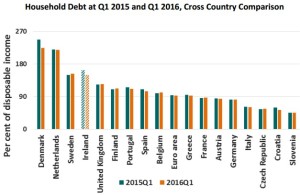
Household Debt Cross Country Comparison

[補足・抜粋excerpts]
1. Net Lending/Borrowing of All Sectors (Chart 1.1 関連)
The domestic economy continued to be a net lender to the rest of the world during Q1 2016, as the net borrowing of government and financial corporations was exceeded by deleveraging by households and non-financial corporations…
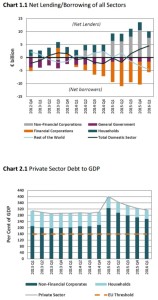
Net LendingBorrowing Private Sector Debt to GDP

2. Private Sector Debt (Chart 2.1 関連)
… CSO revisions to the National Accounts and International Investment Position… redomiciling of some corporations and corporate restructuring… contributed to significant increases in GDP and NFC debt from 2014 onwards. Private sector debt as a percentage of GDP peaked in Q1 2015 at 400.7 per cent, and has since declined substantially to 315.2 per cent in Q1 2016. … primarily by growth in annualised GDP over the period, but is also reflective of falling private sector debt, which has contracted by 3.7 per cent since Q1 2015. …

3. Household Sector
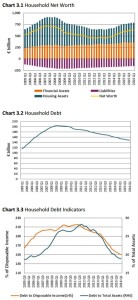
Household Net Worth Debt Indicators

Chart 3.1 関連
… This was partially offset by a decline in households’ holdings of financial assets (€0.5bm). Compared to a post-crisis low of €454.1bn in Q2 2012, household net worth has risen by 38.5 per cent. However, it is still 12.4 per cent lower than its pre-crisis peak of €718bn in Q2 2007.

Chart 3.2 関連
Household debt continued to decrease during Q1 2016, falling by €1.1bn, or 0.7 per cent, to €148.5bn. This represented a household debt per capita of €31,216. Household debt is at its lowest level since Q1 2006. …

Chart 3.3 関連
Indicators of household debt sustainability continued to improve during Q1 2016. Debt as a proportion of disposable income fell over the quarter, from 152.7 per cent to 149.4 per cent, reflecting both the decline in household debt, as well as strong growth in annualised disposable income. …
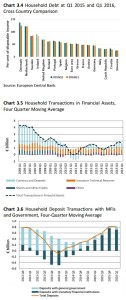
Comparison Transactions in Financial Assets Deposit Transactions with MFIsGovernment

Chart 3.4 関連
… Over the year Danish household debt fell significantly more than any other country examined, declining by 23.2 percentage points. In contrast to this, Swedish households saw a 4 percentage point increase over the same period as they climbed to become the third most indebted in the European Union, with a household debt level of 153.5 per cent of disposable income.

Chart 3.5 関連
… The reduction in financial assets over the quarter largely reflected a fall in transactions of insurance technical reserves. … The majority of households’ financial investments over the quarter were in the form of currency & deposits, while shares & other equity experienced positive transactions for the first time since Q4 2013.

Chart 3.6 関連
… This marked the first time since Q4 2013 that household deposit transactions with MFIs (monetary financial institutions) had declined. In contrast, households increased lodgements with government deposit accounts for the first time since Q1 2013.

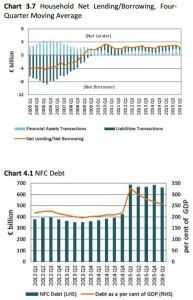
Chart 3.7 関連
… Over recent quarters net lending has become increasingly driven by higher investment in financial assets, as opposed to deleveraging.
Household Net LendingBorrowing NFC Debt

4. Non-Financial Corporation Sector
Irish NFCs are significantly impacted by the activities of large MNCs. These latest NFC results incorporate the recent annual revisions to the CSO’s International Investment Position (IIP). The revisions include large MNCs which redomiciled to Ireland or moved significant parts of their balance sheets to Ireland during 2014 and 2015. These entities also contributed towards some of the very substantial increase in Irish GDP for 2015.

Chart 4.1 関連
… The decline in debt over the past year largely reflected exchange rate movements. Debt as a percentage of GDP fell from 327.5 per cent in Q1 2015 to 257.3 per cent in Q1 2016. This reflected both falling NFC debt, as well as, substantial GDP growth during 2015.
NFC Debt Comparison Loans AssetsLiabilities

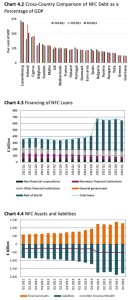
Chart 4.2 関連
… Luxembourg, which also has a lot of large MNCs relative to the size of its economy, had the highest debt at 349 per cent of GDP. … how volatile Irish NFC debt to GDP has been in recent years compared to other euro area countries.

Chart 4.3 関連
… The substantial increase in debt held by non-residents reflects this corporate activity and explains why exchange rate movements have had a significant impact on NFC debt in some quarters. …debt held by Irish residents has been on a downward trend in recent years. …partly reflected NFC deleveraging with Irish MFIs.

Chart 4.4 関連
…largely reflected MNC activities. Net financial assets (financial assets minus liabilities) became even more negative since Q1 2015. This is because some MNCs had large non-financial assets or relocated substantial non-financial assets to Ireland.

“The Creation and Destruction of Value” 価値の創造と破壊 Vol.9

(All the below links are in English.)

Vol.9 金融革命の度合と限界(第4章-2)

 第二の技術革新は、証券が更なる証券の発行によって保証されていることである。一つの債権を細分化する過程で、債務不履行のリスクは債権の他の性質から切り離されるため、理論的には全ての証券が債務不履行しない形即ちリスク無しで購入されることとなる。また、保証人が新たな保証契約を通じてリスクを転嫁することもできるので、債務不履行の際に損害を被る可能性も低い。
 J.P.モルガンが1995年に始めたもう一つの技術革新であるCDS(Credit Default Swap)は、2008年には58兆ドルに達し、世界GDP合計の50兆ドルを抜いていた。非常に小さいリスクと頼りになる手数料のために、AIGインターナショナルやSwiss Reのような大手かつ多角経営の保険会社がこのような保証契約に魅力を感じ取り組んでいた。リスクに対応するために金融当局が定めた自己資本規制比率も結局無駄になった。2003年からの5年間で米欧の10大銀行は資産を倍増し15兆ユーロに達したが、リスク調整資産は5兆ユーロに達したにすぎなかった。

参考
Credit Derivatives Handbook (PDF) | J.P. Morgan
The Value of Risk: Swiss Re and the History of Reinsurance | Peter Borscheid, Harold James, David Gugerli, Tobias Straumann
Global Financial Stability Report, April 2008 | International Monetary Fund

ツイッター paper.li Vol.4

All the below links are in English.

弊社ツイッターアカウントの一つ @WSjp_insight のRTによる paper.li 掲載記事7件を貼っておきます。

Irish economic growth | @RTEbusiness

Ireland’s national accounts | @ucddublin @Aidan_Regan

Soon Your Smart Car Will Also Be an Amazon Locker | @BloombergCA @ElisBehrmann @rweiss5

2016 @BSAnews GLOBAL CLOUD COMPUTING SCORECARD (pdf) | @invest_canada

IMF Backs More BOJ Easing If Coupled With Comprehensive Reforms | @business @RichMiller28

Nagasaki, 1945: “The world did not need your experiment” | @jricole

Rio 2016: What Olympic sports taught 8 leaders about successfully running a business | @Inc @JustinJBariso

“The Creation and Destruction of Value” 価値の創造と破壊 Vol.8

(All the below links are in English.)

Vol.8 金融革命の度合と限界(第4章-1)

 証券化に係る最も最近の根本的な技術革新は、1990年代半ばに始まり、J.P.モルガンが関係している。決定的だったのは、1997年に着手された Broad Index Securitized Trust Offering (BISTRO) であった。この制度では、元々の債権関係が細分化され、簿外単位で証券化され、Structured Investment Vehicle (SIV) として取引された。21世紀に入ると、証券化は不動産ビジネスの形を変え始めた。サブプライム・モーゲージは、認証後に債権に何が起こっても認証者が責任を負わないものであった。
 2005-07年には、5400億ドルの抵当化債務及び不動産証券が創り出された。2009年初期までにはこれらの内1020億ドルが整理され、優先債の32%、メザニン債の5%しか回収されなかったことになる。ジョージ・ソロス曰く、合理的期待形成モデルへの過度な思い入れについては、経済学者は投資銀行員と同様に責任があり、その間違いの代償を払うべきである。

参考
Robert Lucas, rational expectations, and the understanding of business cycles | @LarsPSyll
LIFE AFTER “RATIONAL EXPECTATIONS”?: Imperfect Knowledge, Behavioral Insights and the Social Context [PDF] | Roman Frydman and Michael D. Goldberg
The New Paradigm for Financial Markets: The Credit Crisis of 2008 and What It Means [PDF] | George Soros

“The Creation and Destruction of Value” 価値の創造と破壊 Vol.7

(All the below links are in English.)

Vol.7 2008年世界金融危機(第3章-3)

 第三に人の流れの減少の面である。
 2008-09年の急速な貿易の収縮においては、グローバルな相互の繋がりを縮小させることが政策として選択されたのでは決してなかったが、外国人の求職に反対する国民が英独では過半数を超えるなど国民感情の転換はあった。
 また、2008年には自国に移民が押し寄せ労働市場が崩壊し得るグローバリゼーションの時代になっており、新興国が自国のみで破綻していた1990年代よりも先進国の不安は遥かに大きく、先進国は新興国にカネ・モノ・労働力の市場において徹底した対策を要求していたが本来効果のある対策も徐々に効果的でなくなった。

(あくまで参考:The Rise and Fall of Pyramid Schemes in Albania | Christopher JervisThe Free Movement of Workers in an Enlarged European Union: Institutional Underpinnings of Economic Adjustment | IZAFact Sheets on the European Union | European Parliament

“The Creation and Destruction of Value” 価値の創造と破壊 Vol.6

(All the below links are in English.)

Vol.6 2008年世界金融危機(第3章―2)

 第二に、モノの流れの減少の面である。
 特に、リーマン崩壊の端緒において銀行信用が収縮し貿易金融が儘ならなくなったところ、多くの先進国では半官の金融機関が貿易保証を出せたが、同様のことをできた新興国は殆ど無かった。そのため、アジア・ラテンアメリカ諸国は、買い手が居ても先進国に輸出できなくなってしまった。そして、生産拡大のための精密機械などの輸入もできなくなり、それらを輸出していた日独の輸出は2008年第4四半期には激減した。
 そして、貿易が減ると人は貿易依存を減らそうとするという脱グローバリゼーションの悪循環に陥った。これは、理想的な防衛手法ではないにせよ、デフレーションの増殖を国境で食い止める非常に満足の行く次善の策であった。開放経済では、需要が自国の枠から漏れ外国に職を創出し税も外国政府に行ってしまう “leaky Keynesianism”(漏れるケインズ主義。あくまで参考:Fixing the Economy? Like Filling a Leaky Bucket | @TheRagBlog。)になることがあるためである。
 加えて、欧州では、通貨統合のためのマーストリヒト条約の中核である、公債発行額をGDPの3%以内、公債発行残高を60%以内とする財政ルールは、ケインズ的反循環政策(景気刺激策)を採らねばならない危機においては、放棄されねばならなかったが、それが可能な仏独と不可能な希伊葡に分かれるなど、意思決定力が麻痺してしまった(あくまで参考:Guest Post by Timothy King: Keynesian Policies Under the Fiscal Treaty | Phillip Lane @irisheconomyieGoverning hand: Philip Lane takes charge of Central Bank in recovering economy | @BeesleyIT)。

“The Creation and Destruction of Value” 価値の創造と破壊 Vol.5

(All the below links are in English.)

Vol.5 2008年世界金融危機(第3章―1)

 2008年金融危機が先鋭化するにつれ、20世紀のGreat Depression(世界大恐慌)時の下降局面を想起させる脱グローバリゼーション現象が出てきた。カネ、モノ、人、の流れの減少である。

 第一に、カネの流れの減少である。
 米国の金融機関は、“lender of last resort”(最後の貸し手。参考:Central banks as lender of last resort: experiences during the 2007-2010 crisis and lessons for the future | Dietrich Domanski, Richhild Moessner, and William Nelson。)として金融当局や中央銀行を当てにしているにもかかわらず、国内向けには必ずしも貸し出しに積極的にならなかった。このため、例えば、米国政府によるAIGの救済で恩恵を受けたのは、大口の取引を有していたドイツ銀行、クレディ・リヨネ、UBSと外国金融機関であった。金融危機は、米国において、国際金融の繋がりへの根本的な疑問を呼び起こした。
 また、米国外からも、RBSのような損失が出た金融機関について「RBSの損失の殆ど全ては、米国内での営業上の住宅ローン担保証券商品などのサブプライム・モーゲージにおけるものであり、蘭ABN Amroを吸収したことによる(参考:Banking bailout: The rise and fall of RBS | Gordon Rayner)。英国国民のカネで銀行がこのような無責任な経営をしたことは、間違いだ。」とのブラウン英首相(当時)による批判があった。このとおり、英国政府による救済の重要部分は、RBSの外国支店や外国での事業を売却することであった。

“The Creation and Destruction of Value” 価値の創造と破壊 Vol.4

(All the below links are in English.)

Vol.4 第2章-2  

 他方、1931年のdisasterでは、容易な解決策は無かったが、ハイパーインフレーション(参考:In today’s debt crisis, Germany is the US of 1931 | @flindner23)などを引き起こした愚策の後の銀行のバランスシートの悪化が原因であると明白であった。メガバンクが崩壊した欧州が、小規模地域銀行が主体の米国での不安を煽って、崩壊に導いたと言える。
 一つの解決策としては、1944年のブレトンウッズ会議(参考:Establishment of the Bretton Woods System | @AtlantaFed)での中心的議題であった、逆行しているカネの流れの封じ込めがあったが、民主主義の時代には難しかった。
 もう一つは、1930年代にゴットフリート・ハバーラー(Gottfried Haberler (by @mises))など何人かから指摘された、固定為替制は通貨危機に対して脆弱であるので、為替変動制に移行することであったが、金融制度の未発展国の国民は自国では自国通貨を長期的に調達することができず、常に為替変動リスクに晒されるというものである。尤も、21世紀初頭には、1929回避のための通貨政策と共に、1931回避のための金融機関なども整備されてきた。

日本のガラパゴス症候群 Vol.3(産業構造 | The Information Technology and Innovation Foundation)

本稿テーマの産業構造は、ガラパゴス化と関連はあると考えますが、直接的と言うよりは間接的なものかと考えております。また、この大きなテーマは、弊社が初期段階で承る基本的業務の範囲外であるため、深くは触れません。さらに、もちろん改善改革に向けた事実抽出等のために言わざるを得ない場合がありますが、英語で(国外に向けて)日本の弱点を声高に言うのは好みではありません。他方、日本にとって良くない情報が英語で世界的に公然と日常的に出されているという重みを認識しておく必要があるように考えますので、本稿でも日本語で簡単に挙げておきます。

@ITIFdc(English) が出してから五年半経つらしい The Good, The Bad, and The Ugly (and The Self-Destructive) of Innovation Policy | Stephen J. Ezell & Robert D. Atkinson(English) 30-31頁では、「…日本は本気で非貿易分野の成長に力を入れたことがないので、日本経済の約四分の一を占め世界に名を馳せる輸出者たる製造業だけが日本では成長し、世界レベルのサービス業が存在しないことが目を引く。….輸出外需頼みの国は、輸出市場が飽和してしまえば逞しいサービス業を持つ国に抜かれ衰えてしまう『一つの芸当しかできない子馬』となるリスクを孕んでいる。」とされています。内容が正しいように感じられてしまう現状が改善され、『日本は改革されて真に強くなり、one-trick ponyではなくなった。』、と書かれることになるよう望んでおります。

日本のガラパゴス症候群 Vol.2(Monetary Policy et al. | Milken Institute)

一般論として解決策の検討に入る前に(評価の入らない)事実を正確に把握することが必要であるところ、本件でも事実の捻出のためしばらくこういうものが続きます。

このパネルディスカッション Milken Institute Global Conference は今月行われたものであり、玉石ある中で上質のものであると感じましたので、ご紹介します。何だかんだ言っても世界の動きを創り続けている北米欧州では日本がこのように認識されているということもよく分かりますし、とりわけこの方の日本に係る認識は全般に正しいように感じました。なお、少なくとも私自身は決して日本も含めてQEその他の努力を否定する訳ではありません。