U.S.A. アメリカ Vol.7(articles on US Presidential Election 2016 ー 米国大統領選挙 update)

Here are a part of articles concerning the presidential election. All the below links are in English.

You can check out the following website for policies: worldsolutions.work.
標記につき関連記事を以下貼っておきます。政策については上記URLをご覧ください。

Lewd Donald Trump Tape Is a Breaking Point for Many in the G.O.P. | @nytimes

Election Update: Women Are Defeating Donald Trump | @NateSilver538

US Election 2016: In Conversation with @EdwardGLuce (w Podcast) | @Jparakilas @ChathamHouse

Tracking the Dynamics of the 2016 Election | Catherine Allen-West, Stuart Soroka & Michael Traugott @umisrcps

@ASPI_org suggests | @AmeliaLong222 @davidmlang

Reports of Obamacare’s demise are greatly exaggerated | @crampell @washingtonpost

Putting the Populist Revolt in Its Place | @Joe_Nye @ProSyn

How Trump and Clinton Could Still Draw Undecideds off the Sidelines | @peterwgnd @Columbia_Biz

Trump and American Populism | @ForeignAffairs

How terrible simplicity leads to terrible complexity | @nfergus @BostonGlobe

Voter Opinions on the Candidates, the Issues, and the Parties | Michael Pollard & Joshua Mendelsohn‏ @RANDCorporation

HOW VOTER TURNOUT COULD PUT TRUMP IN THE WHITE HOUSE | Christine Gallagher MPhil student @Pembroke @OxPolBlog

‘Missing’ White Voters Could Elect Trump. But First They Need To Register. | @redistrict @fivethirtyeight

Does Donald Trump’s plan to drill more oil make sense? | @mattmegan5

Hillary Clinton’s ‘Invisible Guiding Hand’ | @ShaneGoldmacher @Politico

How bad is it for Donald Trump? Let’s do the math | @DrewLinzer @dailykos

Forecasting the Presidential Vote with Leading Economic Indicators and the Polls | @CUP_PoliSci

compilation of the winner of every county in every presidential race since 1836 | @kkondik

How social media is shaping the 2016 presidential election | @mattkapko @CIOonline

Why Donald Trump is a ‘click bait candidate’ and Hillary Clinton is too | @JTakiff @PhillyBusiness

Post-truth politics and the US election: why the narrative trumps the facts | @Reasondisabled @UQ_News @ConversationEDU

Podesta Leaks: The Obama-Clinton E-mails | @ANDREWCMCCARTHY @NRO

The lesson about email safety we can learn from Hillary Clinton and Colin Powell | Tara Golshan @voxdotcom

Trump Withheld Alimony From Marla Maples When She Threatened His Presidential Ambitions | @KFILE @BuzzFeed
– “Our purpose was to send a message that she was playing close to the fire. That should slow her down,” Trump’s lawyer said at the time.

Psychology suggests that power doesn’t make people bad—it just reveals their true natures | Michael W. Kraus @qz @StephaneCoteTO @katydec @RotmanSchool

Don’t skip the vice presidential debate: Column | @USATopinion

Read Hillary Clinton’s Historic Victory Speech as Presumptive Democratic Nominee (w Video) | @katiemacreilly @time

3 myths about first presidential TV debate between Kennedy, Nixon (w Video) | @mariemorelli @syracusedotcom

Tocqueville’s America Revisited, Part 1 (w Podcast) | Paul Kennedy & Nicola Luksic @cbc

U.S.A. アメリカ Vol.6(2nd US Presidential Debate 10/9/2016 ー 米国大統領選挙テレビ討論会)

Here are a part of articles concerning the 2nd presidential debate. All the below links are in English.

標記第2回(於:@WUSTL)に関する記事を取り急ぎ以下貼っておきます。

Trump Unpacks Three Decades of Clinton Baggage in Debate | @McCormickJohn,@mniquette @bpolitics

The 5 Most Off-The-Rail Moments In The St. Louis Debate | @TPM

The Best, Worst, and Most Uncomfortable Lines of the Second Presidential Debate | @Jacob_Brogan @slate

US presidential debate: Donald Trump says Hillary Clinton ‘would be in jail’ if he became president | @DavidLawler10,@barneyhenderson,@nickallen789,@Rsherlock @telegraph

TRUMP VS CLINTON IN SECOND U.S. PRESIDENTIAL DEBATE: FULL TRANSCRIPT | @newsweek

FACT CHECK: Clinton And Trump Debate For The 2nd Time | @nprpolitics

Read Live Updates On The Second Presidential Debate | @paigelav @HuffPostPol

THE NASTIEST PRESIDENTIAL DEBATE OF ALL TIME | @JohnCassidy @NewYorker

Donald Trump Goes Full Rage-Monster on Hillary and Bill Clinton | @woodruffbets,@timkmak @thedailybeast

Trump v Clinton: Who won the debate? | @awzurcher @bbc

People are mad about the debate’s unasked questions | @lachancenaomi @theintercept

Presidential candidates refuse to shake hands at second presidential debate. Awkward. | @itvnews

#TrumpTapes “represents exactly” who @realDonaldTrump is, @HillaryClinton says at debate | @BBCBreaking

The 31 Funniest Tweets About the Second Presidential Debate | @emmdib @ELLEmagazine

A memorable, riveting, nasty debate — but will it change the direction of the race? | @WSJ

The Disgraced and Little-Known Generals Backing Donald Trump | NANCY A. YOUSSEF @thedailybeast

It is perilously hard to criticise Donald Trump without seeming to insult his voters | @TheEconomist

Is Hillary Clinton right about Trump supporters? This is what the polling data says. | @JuddLegum @thinkprogress

Critic’s Notebook: A Flailing Trump Tries to Drag Clinton Down With Him in Second Presidential Debate | Frank Scheck @THR

Trump Hosts Women Who Accused Bill Clinton Of Misconduct | @christinawilkie @HuffPostPol

The Clintons’ Christian marriage: The staggering Evangelical hypocrisy over Hillary’s refusal to divorce Bill | @lyzl @Salon

UNPRECEDENTED: Going Into Tonight’s 2nd Debate, Trump’s Unfavorable Rating = 58%, Clinton 53% | @JimHarris

US election 2016: A-Z for what to look for in the second presidential debate | @BBC

After a draw in the second debate, will we see a knockout in the final one? | @JohnJHudak @BrookingsInst

U.S.A. アメリカ Vol.5(PROBLEMS UNSOLVED AND A NATION DIVIDED)

All the below links are in English. Excerpts are on our own.

PROBLEMS UNSOLVED AND A NATION DIVIDED (PDF; September 2016) | @MichaelEPorter, Jan W. Rivkin, @desaimihira, with Manjari Raman – The State of U.S. Competitiveness 2016 Including findings from @HarvardHBS’s 2016 surveys on U.S. competitiveness
抜粋・抄訳です。

EXECUTIVE SUMMARY p.2-5
Key Findings(主な調査結果)
[Chapter 1] The U.S. economy in an era of political paralysis
• Addressing America’s economic challenges requires a common understanding of competitiveness and the true underpinnings of prosperity. We define competitiveness as follows: A nation is competitive to the extent that firms operating there can compete successfully in domestic and international markets while also lifting the living standards of the average citizen. Competitiveness must lead to shared prosperity, in which all Americans have the opportunity to advance economically.
(アメリカの経済的課題に対処するには競争力についての理解を共有し繁栄の基盤を真に増強することが必要である。我々が定義する競争力とは、民間企業が一般市民の生活水準を引き上げつつ国内外の市場で競争に勝てることである。競争力は、全てのアメリカ国民が経済的に前進する機会を持つ、共有された繁栄につながるはずである。)
• U.S. competitiveness has been eroding since well before the Great Recession. America’s economic challenges are structural, not cyclical. The weak recovery reflects the erosion of competitiveness, as well as the inability to take the steps necessary to address growing U.S. weaknesses.
• Our failure to make progress reflects an unrealistic and ineffective national discourse on the reality of the challenges facing the U.S. economy and the steps needed to restore shared prosperity. Business has too often failed to play its part in recent decades, and a flawed U.S. political system has led to an absence of progress in government, especially in Washington.

[Chapter 2] Faltering U.S. economic performance
problemsunsolved-2-1problemsunsolved-2-2problemsunsolved-2-4problemsunsolved-2-6problemsunsolved-2-7problemsunsolved-2-13problemsunsolved-2-14
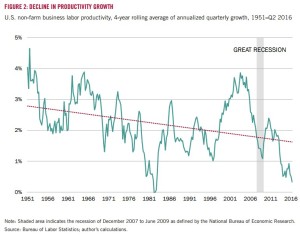
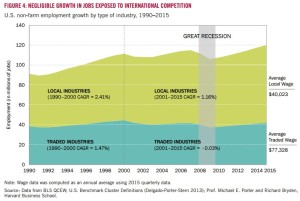
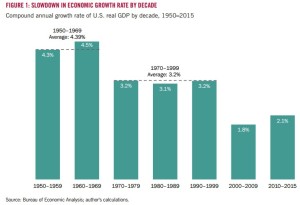
• America’s economic performance peaked in the late 1990s, and erosion in crucial economic indicators such as the rate of economic growth, productivity growth, job growth, and investment began well before the Great Recession.
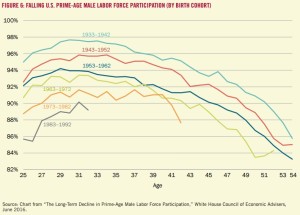
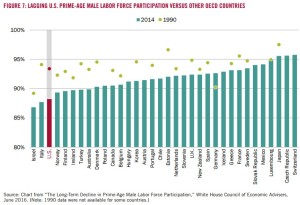
• Workforce participation, the proportion of Americans in the productive workforce, peaked in 1997. With fewer working-age men and women in the workforce, per-capita income for the U.S. is reduced.
(生産的労働力の労働参加は1997年にピークを迎えた。…)
• Median real household income has declined since 1999, with incomes stagnating across virtually all income levels. Despite a welcome jump in 2015, median household income remains below the peak attained in 1999, 17 years ago. Moreover, stagnating income and limited job prospects have disproportionately affected lower-income and lower-skilled Americans, leading inequality to rise.
(実質家計所得の中央値は1999年以来下落し、事実上全ての所得レベルにおいて停滞し続けている。…)
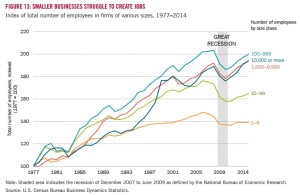
• A similar divergence of performance has also occurred between large companies and small businesses. While large firms have been able to prosper, small companies are struggling, startups are lagging, and small business is no longer the leading job generator.
(… 大企業は繁盛することができたが、中小企業は苦労し、起業者は沈滞し、スモールビジネスはもはや雇用を産み出す牽引役ではなくなっている。)
• Overall prosperity is growing slowly, but the benefits are increasingly not flowing to middle- and lower-income Americans. This puts the American Dream, or the ability of any American to advance and prosper, at risk.

[Chapter 3] An eroding U.S. business environment
problemsunsolved-3-bizenvproblemsunsolved-3-3problemsunsolved-3-4problemsunsolved-3-9
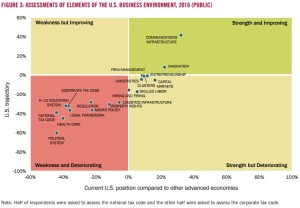
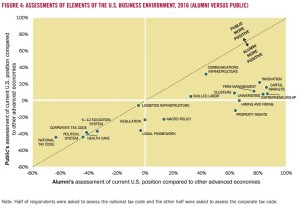
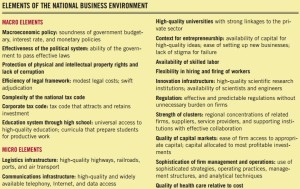
• The U.S. economy retains critical strengths. Business leaders (including HBS students) perceive strengths in areas such as higher education, entrepreneurship, communications infrastructure, innovation, capital markets, strong industry clusters, and sophisticated firm management. However, these strengths are being offset by weaknesses such as the corporate tax code, the K–12 education system, transportation infrastructure, the health care system, and the U.S. political system. Skills have also been eroding and becoming a weakness. Many of the greatest weaknesses are in areas driven by federal policy.
(アメリカ経済は決定的な強みを維持している。… しかし、…弱みに相殺されつつある。スキルも衰え弱みになってきた。多くの最大の弱みは、連邦政府の政策により運営されてきた分野のものである。)
• Alumni working in smaller firms have more negative views of the U.S. business environment than alumni working in larger firms. Members of the general public see the same U.S. competitive weaknesses as HBS alumni but, unlike alumni, perceive far fewer strengths.
• This pattern of strengths and weaknesses helps explain why the U.S. economy is no longer delivering shared prosperity. Large companies, the skilled individuals who run them, and those who invest in them benefit from America’s greatest strengths and are prospering. However, workers and small businesses are captives of the nation’s major weaknesses.
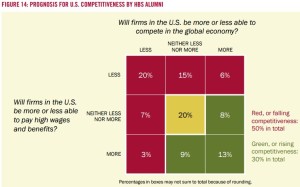
• Pessimism about the trajectory of U.S. competitiveness deepened in 2016, for the first time since we started surveying alumni in 2011. Fifty percent of the business leaders surveyed expect U.S. competitiveness to decline in the coming three years, while 30% foresee improvement and 20% see no change.
• Business leaders and the general public are particularly concerned about the future of American workers: respondents who expect lower pay and fewer employment opportunities for the average American in the future far outnumber those who expect improving worker outcomes.
• Inadequate investment in those parts of the business environment on which middle-class Americans depend (areas like K–12 education and skills), together with lack of policy improvement in areas on which small businesses depend (tax policy, regulations, infrastructure), have undermined overall productivity and shared prosperity.

[Chapter 4] The pressing need for a national economic strategy
• Given the significant challenges facing the American economy, the U.S. needs a national economic strategy more than at any other time in recent history. A strategy is an integrated set of priorities that builds on strengths while acknowledging and tackling weaknesses. It identifies the sequence of steps needed to best move ahead.
• The U.S. lacks an economic strategy, especially at the federal level. The implicit strategy has been to trust the Federal Reserve to solve our problems through monetary policy.
(アメリカには、経済政策、とりわけ連邦レベルのものが欠けている。暗示されている戦略は、連銀が金融政策によって問題を解決してくれるのを信頼することであった。)
• A national economic strategy for the U.S. will require action by business, state and local governments, and the federal government. All three levels have a crucial role to play in restoring competitiveness.
• Taking leadership in improving U.S. competitiveness is a pressing imperative for business leaders. Many companies have failed to invest enough in improving the business environments in the regions in which they operate. Companies can have a major impact on restoring U.S. competitiveness through internal steps such as training and improving opportunities and compensation for lower-income employees. Companies must also step up their role to enhance the business environment in their communities by investing in workforce skills, supporting public education, restoring a local supplier base, and participating in collaborative economic development programs in their regions. We find growing evidence that company attitudes toward investing in competitiveness are improving and this is a welcome development. There are more and more innovative programs underway by business in skills, education, and other areas critical to competitiveness.
(アメリカの競争力を回復させるのにリーダーシップを発揮することは、ビジネスリーダーにとって緊近の責務である。多くの会社は、自分達の事業分野におけるビジネス環境への投資を十分にできていない。会社は、低所得従業員への訓練や機会・手当の改善のような社内対策を通してアメリカの競争力を回復させるのに大きな影響力を持つことができる。…)
• State and local governments must also play a crucial role in improving the business environment, because many of the crucial drivers of competitiveness are local. States and cities need a clear strategy for competitiveness rather than isolated initiatives, and government leaders should foster cross-sector collaborations among local business leaders and other community stakeholders.
(競争力の決定的な推進者の多くは地域に根差しているので、州と市等政府もビジネス環境を改善するのに決定的な役割を担わなければならない。…)
• At the state and local level, the Project has found many examples of innovative steps to enhance competitiveness. Mayors, governors, nonprofit leaders, educators, and businesses are working together in new ways to build workforce skills, invigorate the local education system, upgrade infrastructure, improve the entrepreneurial ecosystem, and develop regional economic strategies. Cities and states across America are moving forward toward competitiveness, but more can be done and best practices need to be shared.
(… 市長、知事、非営利団体リーダー、教育者、ビジネスは、労働力のスキルを創り上げ、地域の教育システムを活気付け、起業的なエコシステムを改善し地方の経済戦略を策定する新しい手法において協働している。…)

[Chapter 5] An economic strategy for Washington
problemsunsolved-5-1problemsunsolved-5-3problemsunsolved-5-4problemsunsolved-5-5
• Efforts by business and state and local government to restore competitiveness cannot deliver their full promise if the federal government does not act. Many of the major weaknesses facing the U.S. are in areas controlled by the federal government.
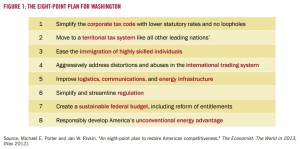
• In 2012, we put forward an Eight-Point Plan of federal policy priorities that would unlock U.S. economic growth and competitiveness. The Eight-Point Plan consists of the following policy recommendations: simplify the corporate tax code with lower statutory rates and no loopholes; move to a territorial tax system like all other leading nations’; ease the immigration of highly-skilled individuals; aggressively address distortions and abuses in the international trading system; improve logistics, communications, and energy infrastructure; simplify and streamline regulation; create a sustainable federal budget, including reform of entitlements; and responsibly develop America’s unconventional energy advantage.
(アメリカの経済成長や競争力の停滞を解き放つ連邦レベルの重点政策であるエイトポイント・プランを、我々は2012年に策定した。税率を下げ抜け穴もなくす法人税法の簡素化、他の主要国同様の源泉地国課税への移行、高度移住者の移入手続の簡素化、国際貿易における歪みや濫用への積極的な対処、物流・通信・エネルギーのインフラ拡充、規制の簡易化・合理化、福祉改革を含む持続可能な連邦政府予算の作成、アメリカのこれまでにないエネルギー優位を責任を持って創り出すこと、を提言している。)
• Each of these areas represents compelling U.S. weaknesses, primarily controlled by the federal government, that can have the most significant and near-term impact on the U.S. economy. There is also wide consensus on the policy change needed to make progress in each area. There are two other crucial U.S. weaknesses, public education and health care, but these are in fields controlled heavily at the state and local levels with no clear consensus yet on solutions.
(それぞれの分野は、アメリカの反論できないほどの弱みを表している。その弱みは、主に連邦政府に権限が握られているものであって、アメリカ経済にとって最も重要かつ近々に影響のあるものであった。また、各分野において進展させるための政策変更をしても構わないというコンセンサスがある。他に二つ、アメリカの決定的な弱みがあり、公共教育とヘルスケアである。しかし、これらは州と市等に大半の権限があるものであり、対処に係る明確なコンセンサスは無い。)
• Progress on even some of these eight priorities would transform the trajectory of the U.S. economy and the economic prospects of all Americans.
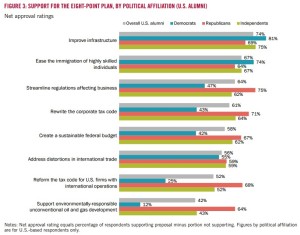
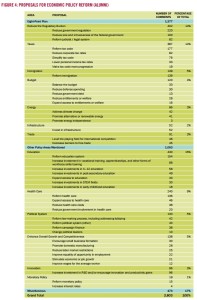
• A strong majority of HBS alumni and HBS students support all eight priorities, with consensus across all political affiliations. When asked in open-ended questions about which priorities alumni felt were most important for federal economic policy, alumni identify virtually the same priorities as those in the Eight-Point Plan. Alumni also mention education, health care, and the political system.
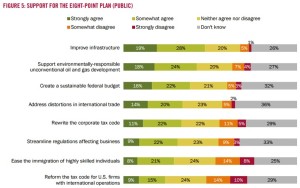
• In the general public survey, there was net positive support for seven of the eight priorities, with a tie on territorial taxes. Public support tended to be somewhat weaker, reflecting the fact that many in the public could neither agree nor disagree, or did not know, whether the eight priorities were good or bad for the economy. Divisive political rhetoric and an uninformed national debate have confused the average American about what the country needs to do to restore the economy. This confusion is a serious obstacle to America’s ability to make progress.
• Despite strong bipartisan support in business and net public support for the Eight-Point Plan, Washington has made very little or no progress on any of these federal economic priorities for well over a decade. The current presidential election is showing no signs of advancing a coherent plan to address these areas.

[Chapter 6] Achieving tax reform
problemsunsolved-6-1problemsunsolved-6-2
• We believe tax reform is the single area with the greatest potential for immediate impact on the economy and is long overdue given changes in the global economy. Corporate tax policy has become a key obstacle to U.S. competitiveness and economic growth, and reforming both corporate and personal taxation is essential to achieving a sustainable federal budget.
(税制が直ちに経済に最大の可能性をもたらす唯一の分野である、世界経済の変化の下で長年の懸案である、と我々は信じている。法人税政策は、アメリカの競争力及び経済成長に対する主な障害となっている。法人税制及び個人税制の改革は、持続的な連邦政府予算の実現にとって必須である。)
• Good tax policy should be guided by the goals of increasing economic efficiency, achieving greater equity, and reducing complexity. The forces of globalization have amplified the inefficiencies and complexities of the current tax system and demand that reform make the U.S. less of an outlier in key tax policy areas – particularly corporate tax policy. Efforts to reduce the negative effects of globalization should be focused on improving competitiveness, for instance, by upgrading the skills of workers threatened by offshoring, rather than on ill-targeted tax policies.
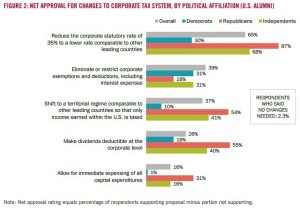
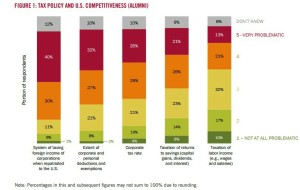
• The top corporate tax problems, according to the surveyed business leaders, are the high corporate tax rate and the taxation of international income. Business leaders report overwhelming and bipartisan support (over 95%) for corporate tax reform. Consensus corporate tax reforms include reducing the statutory rate by at least 10 percentage points, moving to a territorial tax regime, and limiting the tax-free treatment of pass-through entities for business income. The transition to a territorial regime should be complete, not half-hearted via the inclusion of an alternative minimum tax on foreign income. The feasibility of corporate tax reform is promising given the broad consensus on the nature of the problem and the required direction for reform.
(ビジネスリーダーへの調査結果によると、法人税制の一番の問題は、税率の高さと、国際的収入への課税である。法人税制改革には、圧倒的多数かつ超党派で(95%超)の支持が集まっている。法定税率を少なくとも10%下げること、源泉地国課税へと移行すること、パス・スルー法人の事業収入への免税措置を限定すること、などである。…)
• Comprehensive reform of personal taxes will be more challenging. There is less support for many types of personal tax reform. However, there is broad support for instituting a minimum tax on incomes above $1,000,000. Increasing the tax rate on savings; eliminating the deductibility of charitable giving, state and local taxes, and mortgage interest; and taxing employer-provided health insurance did not receive majority support. Respondents support limitations on deductions and exemptions in general but react strongly against them when specific examples are provided.
(個人税制の包括的改革は、もっと困難であろう。多種ある個人税制の改革には、法人税制へほどは支持が無い。しかし、100万ドル以上の所得には最低限の税を課すことには幅広い支持がある。預貯金への税率を上げること、慈善事業への寄付や州市等税さらには抵当金利への税控除を削減すること、雇用主による健康保険へ課税すること、は多数の支持を得なかった。回答者は、税控除や免除を制限することには総論賛成であったが、各論には強い反応があった。)
• Carbon, not consumption, taxes are the best step forward. Carbon taxes are remarkably popular both as a separate revenue raiser and as part of a structural, revenue-neutral reform. In contrast, consumption taxes are quite unpopular and elicit the most spirited commentary, positive and negative, from our alumni. Several recently-proposed new ideas also receive support, including taxing non-C corporation business income, raising the cap on income subject to the payroll tax, and allowing for the deductibility of dividends at the corporate level.
• HBS alumni also strongly support spending reductions as a means to fiscal stability. Nearly one-third chose not only reduced spending, but also reduced taxation. MBA students are much more accepting of tax increases and less supportive of spending cuts.
• To achieve the right kinds of tax reform, leaders must begin to speak more realistically about the fiscal realities America faces. In addition, simplistic, polarizing, and protectionist rhetoric must be avoided. The time for tax reform is long overdue.
• Tax reform can also contribute directly to shared prosperity. The earned income tax credit (EITC) is probably the single most important innovation on the personal tax side over the last two decades. Simplification and expansion of the EITC is a promising direction for reform.

[Chapter 7] A failing political system
problemsunsolved-7-3problemsunsolved-7-78problemsunsolved-7-11
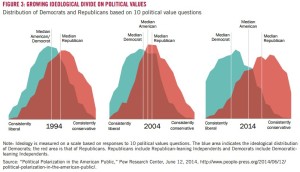
• The U.S. political system was once the envy of many nations. Over the last two decades, however, it has become our greatest liability. Americans no longer trust their political leaders, and political polarization has increased dramatically. Americans are increasingly frustrated with the U.S. political system. Independents now account for 42% of Americans, a greater percentage than that of either major party.
(アメリカの政治システムは、以前は多くの国からの羨望の的だった。しかし、過去二十年以上、アメリカ最大の負の財産となった。アメリカ人はもはや自分達の政治リーダーを信じず、政治の二極化は劇的に増大した。…)
• The political system is no longer delivering good results for the average American. Numerous indicators point to failure to compromise and deliver practical solutions to the nation’s problems. Political polarization has especially made it harder to build consensus on sensible economic policies that address key U.S. weaknesses. It is at the root of our inability to progress on the consensus Eight-Point Plan.
(政治システムは、もはや普通のアメリカ人には良い結果をもたらさない。無数の指標が示すとおり、妥協の失敗、国の問題への実際的な解決策を提供できていない失敗、がある。政治の二極化は、アメリカの主要な弱みに取り組む賢明な経済政策に係るコンセンサスを形成するのを特に難しくしている。…)
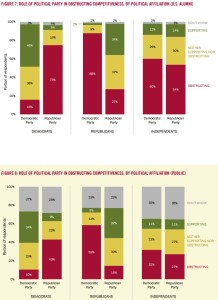
• A large majority of HBS alumni believe the political system is obstructing U.S. economic growth and competitiveness. Many alumni who self-identified as Democrat or Republican blame the other party, but a sizable proportion also hold their own party responsible.
(…政治システムがアメリカの経済成長や競争力を妨害している。…民主党員か共和党員かを自己表明していると他党を責めるが、大きな割合の者達が自党に責任があるとも考えている。)
• Among the general public, many believe that the political system is obstructing economic progress. However, many Americans are unsure, which we attribute to the divisive and partisan dialog on the economy which has confused the public on many issues.
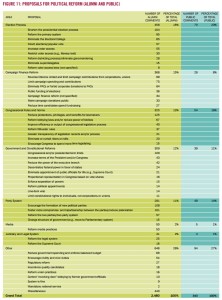
• There is strong support for political reform among surveyed alumni. Of six common proposals for political system reform, a strong majority of HBS alumni support five. The most supported reforms are gerrymandering reform and campaign finance reform.
• Among the general public, the top two political reforms supported are term limits for the House and Senate and campaign finance reform. However, a large percentage of the general public are unsure about which reforms they favor.
• Overall, we believe that dysfunction in America’s political system is now the single most important challenge to U.S. economic progress. Many Americans are keenly aware that the system is broken, but are unsure why it is broken or how to fix it. While there is rising frustration with politics, there is, as yet, no framework for understanding the reasons for today’s poor performance and proposing effective solutions. Identifying such a framework, and the set of reforms that can change the trajectory of our political system, has become a crucial priority.
(… 政治システムが壊れている、と多くのアメリカ人が痛切に感じているが、何故壊れているかどうやって直せるかは分かっていない。政治への不満は高まっているが、今日の貧弱な成果の理由を理解し効果的な解決策を提案する仕組みは無い。…)

U.S.A. アメリカ Vol.4(US Vice Presidential Debate 10/4/2016 ー 副大統領候補テレビ討論会 et al.)

All the below links are in English. Excerpts are on our own.

標記討論会(於:@longwoodu)及び各種政策等に関する米加英豪シンクタンク等による記事の一部のリンク・抜粋を取り急ぎ以下貼っておきます。(本投稿一番下に私見を書きました。)

US Presidential Election 2016 Vol.2 (Who won the vice presidential debate? | @CNNPolitics)

2016 VICE PRESIDENTIAL DEBATE: WHY THESE TWO KEY QUOTES ARE SO IMPORTANT | JUSTIN BUCHLER @CWRU_Polisci @KyleKopko @Newsweek
… Pence, unlike Trump, has always been a conservative hardliner, particularly on issues like abortion. The challenge that this creates is that most voters don’t share his views. Consider the following data from the 2012 American National Election Studies survey. While 45.7 percent of respondents said that women should always be able to attain an abortion as a matter of personal choice, only 11.5 percent said that abortion should never be permitted. …
… Political conflicts can be defined by “lines of cleavage,” Schattschneider wrote. If you want to win, draw the line of cleavage in a place that is beneficial to you, by placing as many people as possible on your side. If you oppose abortion for rape victims (as Pence does), don’t talk about it. …

POLL: Who Won the Vice-Presidential Debate? | @Olivia_Stacey @HeavySan

Mike Pence falls short…of an impossible task | @JohnJHudak
What Pence needed to do
What Tim Kaine needed to do
Don’t blame Mike Pence
Why tonight doesn’t matter
Why tonight’s debate might matter

Pence triumphs in VP debate. And then there was the night’s biggest loser… | @hooverwhalen @fxnopinion

6 things Trump definitely said that Pence claimed he didn’t | @henrycjjackson @politico

Mike Pence Defends Refugee Plan Blocked by Judges | @m_rhodan @TIME

VP debate: Tim Kaine calls Donald Trump ‘maniac’ who could cause nuclear war in tense showdown with Mike Pence | @DavidLawler10

Kaine and Pence to Square Off on Security as Trump Stirs Outrage With PTSD Comments | @MOLLYMOTOOLE‏ @ForeignPolicy

VP Debate: Coming Out of the Shadows | William Harbour @longwoodu @HuffPostBlog

Insiders: Trump will sink Pence in VP debate | @POLITICO_Steve @politico
– ‘Is it just me or are the two VP candidates infinitely more appealing than their running mates?’ said a Pennsylvania Republican.

Vice Presidential Debates Have Mattered Before. Here’s A Look Back | @NPRrelving @nprpolitics

The Fight with ISIS: One Year (and Counting) of Unauthorized War (w Video featuring Sen. Tim Kaine) | @CatoFP

WHY THE VICE-PRESIDENTIAL DEBATE DOES AND DOESN’T MATTER | @JohnCassidy @NewYorker

COMMENTARY: Compare candidates on economy | @DeanBaker13 @cpsj @ceprdc
… This background is important since, in most areas, Clinton would continue and extend policies put in place by Obama, while Trump would reverse them. Starting with taxes, Obama restored the Bill Clinton-era tax rates on high income people. Hillary Clinton has proposed modest further increases in tax rates on the highest income households.
By contrast, Trump has proposed large tax cuts that would disproportionately benefit the richest people in the country. He would go back to the Bush-era tax rates on the very wealthy. This would reduce the taxes on the richest 1 percent by an average of more than $120,000 a year and the richest 0.1 percent by more than $700,000 a year.
He would also eliminate the estate tax, a tax that affects less than 0.2 percent of estates. In addition, he would cut the top corporate income tax rate from 35 percent to 15 percent. Trump’s tax cuts are projected to add $4 trillion to the debt over the next decade.
Clinton wants to keep and extend the Affordable Care Act. She has indicated she wants to make the subsidies in the health care exchanges more generous and give people the option of joining a Medicare-type public plan. She also wants to reduce the cost of prescription drugs by allowing imported drugs and also for Medicare to negotiate lower drug prices.
Trump has said he wants to repeal the ACA as one of his first acts as president. He says that he will replace it, but has not given any specifics.
Trump has also made a big point of saying that he wants to increase U.S. oil, coal and gas production by reducing regulation. It is worth noting that domestic oil and gas production both increased by more than 20 percent under Obama. Coal production is down, but largely because it can’t compete with cheaper alternatives.
Trump has also been eager to claim that he doesn’t believe in global warming and will do nothing to stop it. Clinton accepts the scientific consensus that global warming is a serious threat and will attempt to curb greenhouse gas emissions.
Trump has also complained that the Federal Reserve Board is keeping interest rates too low, implying that he would appoint people who would raise rates and slow the economy. Clinton would presumably appoint people who are more committed to supporting growth and job creation. …

Hillary Clinton, Donald Trump and the Economy | @DeanBaker13 @InsideSourcesDC

History is clear—high tariffs and trade wars devastate countries | Fred McMahon @FraserInstitute

Clinton Estate Tax Plan Would Affect Many Families, Not Just the Very Rich | @PatrickTyrrell1 & Michael Arango @Heritage @DailySignal

Climate Change Can’t Get Traction In This Election, But Clean Energy Can | @JeffMcMahon_Chi @forbes

Compare the Candidates | @CFR_org
– See where the next Commander-in-Chief wants to steer the United States on the most pressing foreign policy issues.
– Who Are the Vice Presidential Candidates?

Clinton and Trump: Commanders-in-Half | Gary Schmitt & James Cunningham @AEI @RealClearNews

Donald Trump’s sycophant problem | @DLind @voxdotcom
– Presidents need to hear bad news. Donald Trump can’t handle it.

How Clinton’s or Trump’s Nominees Could Affect the Balance of the Supreme Court? | ADAM LIPTAK and ALICIA PARLAPIANO @nytimes

The US election is dangerous for Australia | Paul Dibb @ANU_SDSC @ASPI_org

Simplifiers v. complicators | @nfergus @BostonGlobe

私見:リンク一番上の@CNNPoliticsの@David_Gergen教授の下線部分〔概要:有権者は討論の細かい内容を調べるということはほとんどせず、その替わりに討論全体のトーンや候補者の出来の雰囲気を見て判断をする。ペンス氏の発言は必ずしも事実に相違しないこともないが、彼の落ち着きやすっきりした感じは有権者にウケた。良かれ悪しかれ、この種の討論会ではこういうスタイルが重要である。〕が、本討論会の時間帯には良く当てはまると感じました。どのような場合でも記事によっては、後で尾鰭が付き過ぎて実際とかけ離れている、党派性等が非常に濃い、更には、全然理解ないまま書かれている、などが有り得ます。今年の大統領選挙は現時点ではまだどちらに転ぶか分からない、従来ほとんど影響力を持たなかった副大統領候補テレビ討論会が今後投票日までに意外な影響を及ぼす可能性もある、と感じています。

U.S.A. アメリカ Vol.3(1st US Presidential Debate 9/26/2016 ー 米国大統領選挙テレビ討論会)

All the below links are in English. Excerpts are on our own.

1960年(参考:1st Kennedy-Nixon debate (YouTube))や1980年には選挙の帰趨を決したとも言われるのが、 Presidential Debate です。標記第1回(於:@HofstraU)の内容に関する記事の抜粋等を取り急ぎ以下貼っておきます。

Trump And Clinton Sounded As If They Were Talking About Two Different Countries | @bencasselman @fivethirtyeight
Trade
… U.S. manufacturing employment has been hit by automation as much as by globalization, and most economists think trade with China has had a much bigger impact on the economy than NAFTA. …
… But in recent years, research has found that the negative effects of trade — lost jobs, lower wages — last longer than previously believed. Economists once thought that Rust Belt communities, or at least their residents, would rebound quickly from the loss of factory jobs; that hasn’t happened. …
Taxes
… On Monday, however, Trump largely abandoned his populist rhetoric on taxes and instead embraced more traditional Republican talking points: Cutting taxes, including on the rich, he argued, will lead them to invest more in companies and create jobs, while lowering and restructuring corporate taxes will encourage businesses to bring back money stashed overseas. Many economists agree that, all else equal, lowering taxes will tend to boost economic growth. But few believe Trump’s plan would deliver as much of an economic boost as he claims. … 
Crime and policing
… The candidates offered different policy approaches: Trump called for more aggressive policing, singling out New York’s abandoning of its “stop-and-frisk” policy under Mayor Bill de Blasio. Trump said the controversial policy worked; Clinton said it discriminated against minority residents. (Holt pointed out that the policy had been ruled unconstitutional by a federal judge; Trump said the ruling would have been reversed if it had been appealed.) Clinton instead called for gun restrictions, including universal background checks (which research has suggested could help reduce gun killings) and broader criminal justice reform, including abandoning mandatory-minimum sentences, which she said “have put too many people away for too long, for doing too little.” …

Presidential fireworks: The verdict | David Ribar @MelbInstUOM, @LaurenRosewarne @unimelb, James Cahill @Government_UoM; @electionwatch_, Election Watch USA
POLICY
… It was also a surprisingly effective policy battle – though fought using completely different tactics by the two candidates.
Viewers who wanted policy details got heaps of information from Clinton, who offered a comprehensive list of initiatives to grow the American economy, improve outcomes for the country’s middle class, strengthen policing, heal race relations, address the problems of America’s inner cities, counter cyber vulnerabilities, and fight ISIS.

… Trump’s strategy, however, wasn’t to offer policy specifics but rather to discredit Clinton’s and thereby discredit her. In this regard, Trump’s responses were nothing to sniff about – though sniff and sniffle he did. In every segment of the debate Trump emphasised the country’s problems – job losses, rising murder rates, and increasing threats at home and abroad.
Trump followed this litany of woe with effective criticisms of the failure of politicians generally, and of President Barack Obama and Clinton specifically, to address these problems. He repeatedly asked Clinton why she didn’t fix these problems during her long years of service. Trump clearly played to his strengths as an outsider. …
PERCEPTION
For the first couple of moments, Trump’s tone was under control. Clinton’s was shaky, her sentences over-rehearsed. Initially he accomplished a natural, off-the-cuff persona. She was stiff and awkward. …
… He went so far as to pat himself on the back for not saying “something extremely rough to Hillary”, all the while being unable to resist the siren’s call of fat-shaming ­– apparently the cyber attack on the Democratic National Committee could have been “someone sitting on their bed that weighs 400 pounds,” and, hilariously, the tried and true ‘you-love-it-so-much-why-don’t-you-marry-it’ schoolyard zinger of “the Iran deal that you’re so in love with”. …
POLITICS
… Forced to answer, I’d say Clinton, but this was no knockout. Her performance will likely help her make some progress with her intended audiences – moderate Republicans uncomfortable with Trump and wavering young Democrats. Trump largely stuck to his standard message and it would be unlikely if he won over many voters not already in his camp. …
… Strategically, I don’t think this debate will help Trump move beyond his apparent polling ceiling of roughly 43-44%. The part of the Republican voting coalition that is most resistant to Trump’s candidacy are college-educated, white, married women. Over-reliance on his well-known material and repeatedly interrupting Clinton are not likely to change the minds of many of these voters. …

Damned by Faint Trump | @KoriSchake @ForeignPolicy
– Last night’s debate was nothing to crow about on either side, but Hillary Clinton definitely got the better of her rival.
… But it wasn’t horrible — it had substantive moments — and that’s noteworthy this election cycle. Hillary Clinton lived up to her Saturday Night Live impersonation of shrewdness, came locked and loaded with oppo research on Donald Trump’s taxes, business practices, the name of a woman he demeaned, policy citations … and gave Trump all the rope he demanded to explain himself at length. She did some A+ trolling, chipping his vanity and counting on his inability to restrain himself. It was a successful strategy. Trump landed several solid blows but simply lacked the discipline to drive home the points (for example, on her emails). His insistence on his “temperament” as his best quality was refuted by his performance. …
… I thought she missed the chance to bash Trump about his Russian connections. Her policy recommendations are also pretty weak: declaring we won’t permit states to target our private or government information, and that we have tools we could use and will defend our citizens. She seems innocent of the hostility most tech firms have toward Washington, breezily counting on working with them. …
Trump repeated much nonsense… claiming Iran was “ready to fall” before the nuclear agreement propped the government up, falsely claimed he convinced NATO to start looking at terrorism, weirdly claimed that “all of the things she is talking about could have been taken care of in the past 10 years when she had immense power.”
He revisited his standard complaints about America’s unaffordable alliance relationships, giving Clinton her best moment of the night as she spoke to reassure America’s allies that our country will honor our mutual defense treaties and can be trusted to keep its word. It pretty well defanged his claim that “she’s got experience, but it’s bad experience. And this country can’t afford to have another four years of that kind of experience.” …

Trump, Clinton debate fact-checks (a running collection) | @YLindaQiu @PolitiFact
Here are 33 claims from Clinton and Trump, fact-checked. …(17 claims as below)
Clinton: Trump’s tax plan would deliver “the biggest tax cuts for the top percent of the people in this country.”
Clinton: “He started his business with $14 million, borrowed from his father.”
Trump: “My father gave me a very small loan in 1975, and I built it into a company that’s worth many, many billions of dollars, with some of the greatest assets in the world.”
Clinton: “In fact, Donald was one of the people who rooted for the housing crisis. He said, back in 2006, ‘Gee, I hope it does collapse, because then I can go in and buy some and make some money.’ Well, it did collapse.”
Clinton: “Independent experts have looked at what I’ve proposed and looked at what Donald’s proposed, and basically they’ve said this, that if his tax plan, which would blow up the debt by over $5 trillion.”
Trump: The Obama administration “has doubled” the national debt in eight years.
Trump: “You go to New England, you go to Ohio, Pennsylvania, you go anywhere you want, Secretary Clinton, and you will see devastation where manufacturing is down 30, 40, sometimes 50 percent.”
Trump: “Now, look, we have the worst revival of an economy since the Great Depression.”
Trump: “You will learn more about Donald Trump by going down to the Federal Election Commission” to see the financial disclosure form than by looking at tax returns.
Clinton: “You’ve taken business bankruptcy six times.”
Clinton: “You even at one time suggested that you would try to negotiate down the national debt of the United States.”
Trump: “In Chicago, they’ve had thousands of shootings, thousands since January 1st. Thousands of shootings.”
Clinton: “Donald started his career back in 1973 being sued by the Justice Department for racial discrimination because he would not rent apartments in one of his developments to African-Americans.”
Trump: “I settled that lawsuit with no admission of guilt.”
Clinton: “I was so shocked when Donald publicly invited Putin to hack into Americans. That is just unacceptable.”
Clinton: “He actually advocated for the actions we took in Libya and urged that Gadhafi be taken out, after actually doing some business with him one time.”
Clinton: “John Kerry and President Obama got a deal that put a lid on Iran’s nuclear program without firing a single shot.”

Clinton Prevails in Downer of a Debate | @amyewalter @CookPolitical

Producing “The Choice” – Frontline’s Documentary on the 2016 Presidential Candidates (Soundcloud) | @DukeSanford

Many Young Voters Remain On The Fence After First Debate (w radio) | @asmamk @NPR

Poll: Clinton Leads Trump Ahead of First Debate | @mmurraypolitics(9/21)

Debating the debates | @cpazzanese @Harvard Gazette(9/22)
– Harvard analysts ponder the upcoming presidential clashes, how viewers may react, and how the candidates might snare their votes

Polls: Clinton Running the Table in Key Battlegrounds | @mmurraypolitics(8/12)

New September Electoral College Ratings | @amyewalter @CookPolitical(9/23)

The Race Tightens But the Math Heavily Favors Clinton | @CharlieCookDC @CookPolitical(9/20)

“The Creation and Destruction of Value” 価値の創造と破壊 Vol.5

(All the below links are in English.)

Vol.5 2008年世界金融危機(第3章―1)

 2008年金融危機が先鋭化するにつれ、20世紀のGreat Depression(世界大恐慌)時の下降局面を想起させる脱グローバリゼーション現象が出てきた。カネ、モノ、人、の流れの減少である。

 第一に、カネの流れの減少である。
 米国の金融機関は、“lender of last resort”(最後の貸し手。参考:Central banks as lender of last resort: experiences during the 2007-2010 crisis and lessons for the future | Dietrich Domanski, Richhild Moessner, and William Nelson。)として金融当局や中央銀行を当てにしているにもかかわらず、国内向けには必ずしも貸し出しに積極的にならなかった。このため、例えば、米国政府によるAIGの救済で恩恵を受けたのは、大口の取引を有していたドイツ銀行、クレディ・リヨネ、UBSと外国金融機関であった。金融危機は、米国において、国際金融の繋がりへの根本的な疑問を呼び起こした。
 また、米国外からも、RBSのような損失が出た金融機関について「RBSの損失の殆ど全ては、米国内での営業上の住宅ローン担保証券商品などのサブプライム・モーゲージにおけるものであり、蘭ABN Amroを吸収したことによる(参考:Banking bailout: The rise and fall of RBS | Gordon Rayner)。英国国民のカネで銀行がこのような無責任な経営をしたことは、間違いだ。」とのブラウン英首相(当時)による批判があった。このとおり、英国政府による救済の重要部分は、RBSの外国支店や外国での事業を売却することであった。

姉妹都市 Vol.3(Tripartite Economic Alliance ロサンゼルスLA=オークランドAK=広州GZ 三市経済連携)

今日は”サミット”の話、と言っても先月下旬の議長国日本・伊勢志摩G7の話ではありません。〔以下ツイッターリンクは中国の広州市Guangzhouも含めてEnglish、日本の各市町のホームページはそれぞれ。〕

ロサンゼルス市(LA、人口380万人、アメリカ。参考:@MayorOfLA 市長)・オークランド市(AK、市人口40万人強・都市圏人口150万人、ニュージーランド。参考:@Auckland_NZ 市役所)・広州市(GZ、人口1300万人、中国。参考:@Guangzhou_City 市役所)の相互に姉妹都市である三市による Tripartite Economic Summit 2016 三市経済サミット が先月中旬にオークランドで開催されました。21世紀の都市間交流のあり方を打ち立てるべく2014年11月に世界初の三市経済連携協定(Tripartite Economic Alliance agreement)が結ばれ、初回”サミット”が昨年6月にロサンゼルスで開催されたとのことです。

都市間交流・地域間交流は一対一・文化交流という形である印象がありますが、太平洋を跨いだ三大都市の継続的な経済連携枠組みで世界初というのは第一印象としてはインパクトがあります。もちろん細部を少しずつ継続的に理解して行く必要がありますが、民間企業が収益を上げるのに役に立つ経済連携の形を取れば地方公共団体にも(もちろん中央政府にも)予算的労働的に負担がかからないということは言えます。また、人間で言えば、二人の方が突っ込んだ内容を話せるけど三人以上の枠組みの方が派手だったり長持ちしたりもする(あくまで参考:下記※)、というような感じでしょうか。従来型交流と適宜並行して進むと良さそうです。
なお、上記三市の日本の姉妹都市は、ロサンゼルス市とは名古屋市(参考:名古屋市英語ホームページ)、オークランド市とは大阪市(参考:大阪市英語ホームページ)・福岡市(参考:福岡市英語ホームページ)・富岡町(友好都市。参考:福島県富岡町ホームページ。)・宇都宮市(参考:宇都宮市ホームページ)・品川区(参考:品川区英語ホームページ)、広州市とは福岡市、のようです。また、広州市の姉妹都市には、当都市経済連携には入っておらず、ニュージーランドとは隣国かつ同盟国であるオーストラリアのシドニー市(参考:@cityofsydney 市役所)もあり、先月で両市姉妹都市30年になり喜ばしいとの報道が何度か目に入ってきました。シドニー市の姉妹都市には日本の名古屋市もあります。

※ 各人が手抜き無しに努力を怠らないチームの人数は、例えばWhy Less Is More in Teams | Mark de Rond では、4人とされています。他方、適度な頑張りが必要となる姉妹都市経済連携のような組織間の持続的試みにおいては、検証等必要ですが、各者が一定程度以上望んでいれば3者というのが一番長持ちしそうだと第一感では思いました。

U.S.A. アメリカ Vol.2(U.S. Top10 high-tech cities アメリカ国内ハイテク産業10都市等)

Data don’t lie… U.S. high-tech cities(English)で取り上げたシンプルな記事以外にも様々な記事が出ていますが、概括的に傾向を見るには足りる記事かと思われます。補足として一応ネットで拾ったのが、添付の2~4番目の図表であり、記事と直接の関係はありません。
この記事で当然ながら面白いと思ったのは、アメニティ密度、徒歩移動可能範囲、ハイテク産業集団度、地域経済の活気が”market dynamism”としてランキング決定指標となっていることです。人間が気持ち良く生活して働いてこそ仕事の成果が上がるという当たり前のことがハイテク業界では(一番進んでいるからこそ?)基本におかれている、と考えます。

“The Creation and Destruction of Value” 価値の創造と破壊 Vol.3

(All the below links are in English.)

Vol.3 1929年と1931年(第2章ー1)

 1929年と1931年は対照的であった。
 1929年の崩壊は、公開市場操作(参考:Open Market Operations (OMOs))による流動性の増加(参考:Market Liquidity)と伝統的な通貨政策(参考:The Federal Reserve’s Unconventional Policies)という二つの非常にもっともな解決策があったが、原因は未だ解明されていない。正確には、原因の合理的な説明として二つ可能性のあるものがあるが、必ずしも満足なものではない。

 その一つは、投資家が米国経済停滞の予兆を見て、1907年10月の崩壊などを想起し、それに対応して投資を控え、世界大恐慌に陥ることとなったというもの。しかし、例えば、崩壊初期の1930年における消費の落ち込み30億ドルのうち13億ドルしか崩壊パニックによっては説明が付かない。
 もう一つは、個人や会社がカネを借りる際の担保がパニックにより減り、世界大恐慌の特徴とされる(証券投資などに回すために銀行から預金が大量に引き出される)金融仲介機能の崩壊(参考:Credit Availability and the Collapse of the Banking Sector in the 1930s)を引き起こしたというもの。しかし、ロバート・シラー教授(参考:Yale@RobertJShillerProjectSyndicate)も言うように、歴史的比較からの崩壊の想起無くしては語れない。欧州やアジアにパニックが広がらなかったのが驚きではあるにしても。

姉妹都市 Vol.2(松島町とイルデパン島、岩沼市とナパ市・ドーバー市)

Vol.1掲載姉妹都市一覧のとおり、同じ宮城県内隣接及びニューカレドニア内のペアで 松島町 Matsushima TownIle des Pins イルデパン島(和訳すると松島)もあります。
さらに宮城県について言えば、例えば、県内の 岩沼市 Iwanuma City とアメリカのカリフォルニア州内のナパ市、デラウェア州内の Dover City ドーバー市 が姉妹都市であり、 宮城県 Miyagi PrefectureState of Delaware デラウェア州 は姉妹州でもあります。