ツイッター paper.li Vol.6

All the below links are in English.

弊社ツイッターアカウントの一つ @WSjp_insight のRTによる paper.li 掲載記事5件を貼っておきます。

@RBAInfo Bulletin June Quarter 2016 | @WSjp_insight

A new trade commission has warned the UK to treat China with “kid gloves”, and focus on attempts to secure deals with countries with “similar values” | @MkSands @CityAM

Spain’s Northern Coast by Private Rail | @ffdunlop @NatGeo

LifeSciences grant: 2016 Laureates #iGEM | @FranceScience

Franz Ferdinand, Whose Assassination Sparked a World War | @DSlotnik @nytimesworld

Australia オーストラリア Vol.4

(All the below links are in English.)

オーストラリア中央銀行 Reserve Bank of Australia の 2016年第2四半期 Bulletin June Quarter 2016 | @RBAInfo をご紹介します。

1. Household Wealth in Australia: Evidence from the 2014 HILDA Survey | Paul Ryan and Tahlee Stone(オーストラリア国民の家計の財産状態)

[概要abstract]
This article uses data from the Household, Income and Labour Dynamics in Australia (HILDA) Survey* to assess how the distribution of wealth changed for Australian households between 2010 and 2014. Average household wealth increased modestly over that period, driven mainly by growth in the value of financial assets, most notably superannuation. The growth of housing wealth was slow in comparison, particularly in Queensland and Western Australia. While most of the changes in wealth were broadly based across households, wealth increased more rapidly for those residing in New South Wales and for retired households with large holdings of superannuation and equity assets.
(本論文は、オーストラリア家計収入労働関係性HILDA調査のデータを使って、2010年から2014年の間のオーストラリア国民の富の分配の変化を評価している。この期間、主に、金融資産価値、最も知られているものでは退職年金の増加によって、平均的な家計の富は緩やかに増加した。特にクイーンズランド州や西オーストラリア州では伸びは鈍い一方、ニューサウスウェールズ州では急速に伸びた。)
** Australian System of National Accounts (ASNA)
*** Australian Bureau of Statistics (ABS) Survey of Income and Housing (SIH)

[補足・抜粋/excerpts]
Introduction
… As the general distribution of household wealth (i.e. total assets minus total debts) across, these categories is broadly the same in 2014 as it was in 2010, this article focuses on how the distribution of housing assets (including investment properties), non-housing assets (predominately superannuation) and household debt have changed between 2010 and 2014.
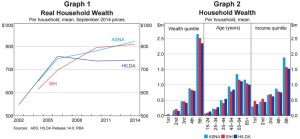
The HILDA Survey* data suggest that the average Australian household had total wealth of around $740 000 in 2014. Measures of real (inflation adjusted) wealth per household from the HILDA Survey grew a little less over the decade to 2014 than measures based on household-level data from the SIH*** and distributional wealth indicators from the ABS that are consistent with aggregate data from the ASNA** (Graph 1).
graph12
Looking at the cross-sectional distribution of household wealth, older and higher-income households tend to have higher levels of wealth (Graph 2). …

Household Wealth
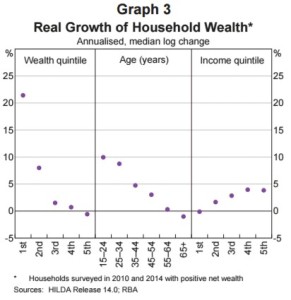
Overall, almost 60 per cent of households in the HILDA Survey had more real wealth in 2014 than was the case in 2010. Households with the lowest levels of wealth in 2010 saw the most growth of wealth over the four years to 2014 (Graph 3). This partly reflects the fact that low-wealth households are generally young and are just starting to build wealth. …
graph3

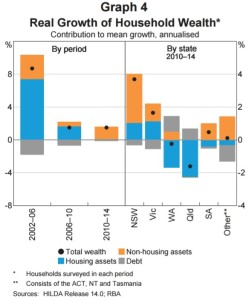
… most of the increase in wealth over the 2010–14 period came from growth in the value of non-housing assets, which are predominantly financial assets such as superannuation, equities and deposits (Graph 4). …
graph4

… Households in New South Wales and Victoria saw the largest increase in wealth, with growth in both housing and non-housing assets, while households in Queensland and Western Australia saw the biggest decrease in wealth, on average, mainly owing to a fall in the value of housing assets. The other states and territories generally saw relatively little growth in wealth over the period. The outcomes for households in Queensland and Western Australia are likely to have been influenced by the decline in commodity prices and the mining investment boom following the peak, which occurred between 2010 and 2014. …

Housing Assets
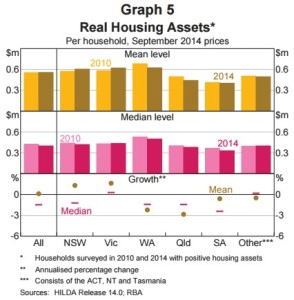
Housing is the largest asset class on Australian households’ balance sheets, accounting for around 60 per cent of total assets. Over any given period, growth in housing assets can be due to a change in housing prices or a change in the stock of housing held by Australian households. …Looking more closely across the states reveals large differences in the mean and median values of housing assets (Graph 5). …
graph5

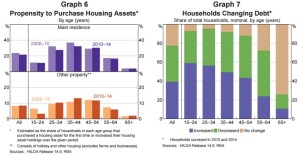
… the share of households that either became home owners for the first time or upgraded their main residence decreased relative to the 2006–10 period (Graph 6). …Households in New South Wales and Victoria were slightly more likely to increase their holdings of other property than was the case from 2006 to 2010.
graph67

Household Debt
… High-income households hold the majority of debt. The top income quintile held almost 50 per cent of the stock of household debt in 2014. Almost a third of households held no debt, with the majority of these being retired households.
Over the four years to 2014, about 40 per cent of households increased their levels of nominal debt, while a similar share of households reduced their holdings of debt (Graph 7). …

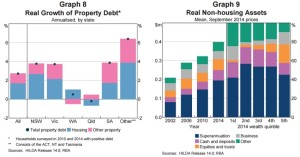
Property debt accounted for a little over 80 per cent of the stock of debt held by households in 2014. Average debt increased modestly from 2010 to 2014, by a little more than 2 per cent per year (Graph 8). …
graph89

Non-housing Assets
… The mean value of real non-housing assets increased from around $320,000 in 2010 to almost $400,000 in 2014 (Graph 9). … Wealthier households held a higher-than-average share of assets in the form of direct equity holdings and business assets, while households with lower net wealth held more in cash and deposits, superannuation and durable goods (Graph 9).

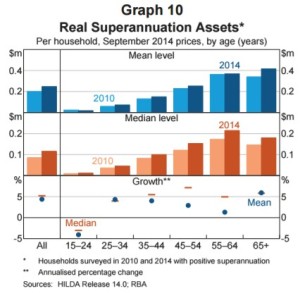
The mean superannuation balance grew by around 4 per cent per annum in real terms for all households over the period to $250,000 in 2014 (Graph 10). … The noticeably stronger growth in median superannuation assets relative to the mean for households aged 45 to 64 years suggests that the ‘typical’ (or median) household in these age groups are building up superannuation assets faster in the lead-up to retirement than the households in the same age group with the largest balances of superannuation (Graph 10).
graph10

Conclusion
… The main driver of growth in household wealth over that period was an increase in the value of financial assets, mostly superannuation assets. Weaker growth in housing wealth, with declines in Queensland and Western Australia, contributed to the slower growth in total wealth from 2010–14. …

2. Conditions in the Manufacturing Sector | Sean Langcake(製造業界の現状)

[概要abstract]
Manufacturing output and employment have fallen steadily as a share of the Australian economy for the past three decades. This article looks at the composition of the sector and draws on the Reserve Bank’s liaison with manufacturers to provide an insight into some of their responses to the structural challenges in recent years. According to liaison, the increase in the supply of manufactured goods from low-cost sources abroad, exacerbated by the appreciation of the Australian dollar during the period of rising commodity prices, impaired the viability of many domestic manufacturers and precipitated the closure of some manufacturing production over the past decade. While the recent exchange rate depreciation has helped to improve competitiveness of Australian producers, so far there is only limited evidence of a recovery in manufacturing output and investment.
(オーストラリア経済において、製造業の生産と雇用は、過去三十年着実に低下してきている。ここでは、近年の経済構造の変化への製造業者の対応を洞察する。コモディティ価格上昇期に豪ドル高となったため、低コスト製品が海外から流入し、それがオーストラリア国内製造業者の価値を損ない、過去十年の製造業者閉鎖を促進した。最近の為替レート低下によりオーストラリア製造業者の競争力は改善されている一方、製造業者の生産と投資が回復してきている証拠はまだ限定的である。)

[補足・抜粋/excerpts]
Introduction
… It currently accounts for around 7 per cent of total output and employment. … over the 2000s, strong Asian demand for Australian commodities led to a sharp increase in the terms of trade and an appreciation of the Australian dollar. …

Manufacturing in Australia
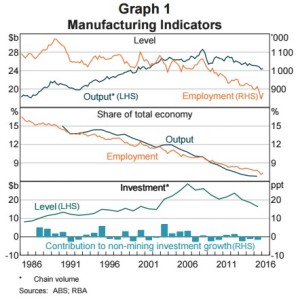
Manufacturing output increased steadily throughout most of the 1990s before plateauing in the early 2000s; output today is around the same level it was just over a decade ago (Graph 1). … Over the past two decades, the Australian economy as a whole has grown considerably, resulting in a marked decline in manufacturing output as a share of total output. Employment in manufacturing has also declined over the past two decades, with growth in labour productivity in line with that of the economy as a whole. …
…investment in the manufacturing sector has also fallen steadily since its peak in 2005/06 (Graph 1). …
graph_1

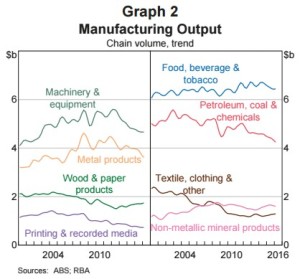
Australia’s manufacturing sector is quite diverse and is comprised of several sub-industries, the largest being: food, beverage & tobacco; machinery & equipment; petroleum, coal & chemicals; and metal products (Graph 2). …
graph_2

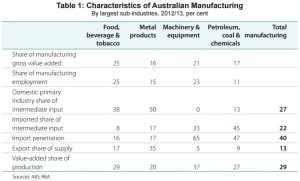
The food, beverage & tobacco and metal products sub-industries both rely heavily on inputs from primary industries (agriculture and mining) where Australia has an abundant supply, and use a relatively low share of intermediate components that are imported. …
Conversely, the machinery & equipment and petroleum, coal & chemicals sub-industries use relatively few inputs from primary industries in Australia and have a relatively high share of imported intermediate components. …
table_1

The International Context
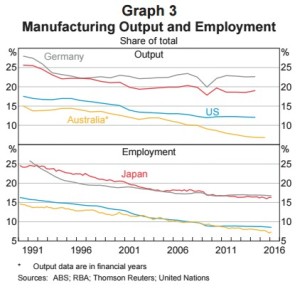
Over the past 25 years, most advanced economies have seen their manufacturing sectors recede as a share of both output and employment, although Australia has generally had a lower share than many other advanced economies (Graph 3).
graph_3

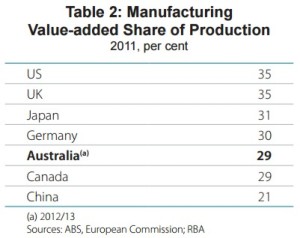
The ratio of value added to total production in the Australian manufacturing sector is broadly comparable to that in other advanced economies’ manufacturing industries (Table 2). Relative to other Australian industries, manufacturing is a low value-added sector; the ratio of value-added to total production (29 per cent) is the lowest of any industry. …
table_2

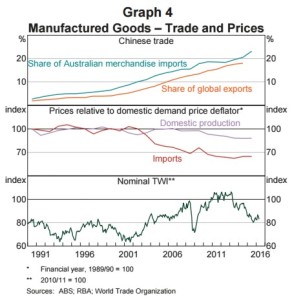
… The steady increase in China’s share of Australia’s merchandise imports has coincided with a fall in the prices of imported manufactured goods relative to domestic production (Graph 4).
graph_4

The Australian Dollar and Implications for Competitiveness
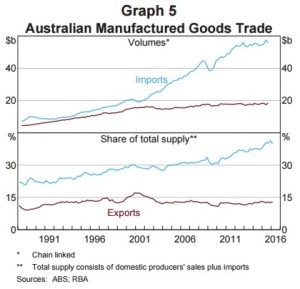
The appreciation of the Australian dollar from 2000 to 2013 worked against the international competitiveness of Australian manufacturing (Graph 4). Exports of Australian manufactured goods grew slowly over this period as they became relatively more expensive overseas (Graph 5). …
graph_5

… Typically, contacts maintain some productive capacity in Australia, either as a testing or research and development (R&D) facility, to protect their more sensitive intellectual property, or to be able to fill orders more quickly. Nevertheless, firms that have ‘offshored’ production typically have much less productive capacity remaining in Australia than their overseas operations. …
…there are significant lags between a depreciation of the dollar and a response in manufacturing production and exports due to the nature of supply chains. For instance, even though domestic producers have become more competitive against imported products, retailers or other manufacturers may have contracts that secure supply in advance, which inhibits their ability to switch to domestically produced products. …
…they responded to the appreciation of the dollar by importing more goods, either by choice or necessity as production of some inputs had moved offshore. … while the lower value of the dollar aids demand, margins are under pressure due to rising import costs in instances where local substitutes are not readily available.

Domestic Input Costs and Implications for International Competitiveness
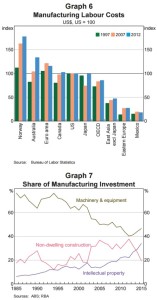
… Australian manufacturing labour costs appear to be relatively high compared with those in other economies – a feature that has become more pronounced over time (Graph 6). …
graph_67

…firms have been looking to find labour productivity gains by automating some production processes. They have also been developing new products to diversify their offering. These shifts are borne out in the nature of firms’ investments; increasingly, manufacturers are investing in intellectual property rather than physical capital (Graph 7). …

…foreign-owned manufacturing firms operating in Australia are more willing to invest in R&D than physical capital in their Australian subsidiaries, although it is difficult to quantify what share of manufacturing activity is accounted for by these firms. …

Difficulties Integrating in Supply Chains
…other economies have responded to pressure from cheaper, imported manufactured goods by integrating themselves more effectively into increasingly fragmented global supply chains. … Australia’s geographic isolation contributes to high trade costs and presents a significant impediment to greater participation in global supply chains. …the costs of trading Australia’s manufactured goods – largely international transport costs – are in the order of 20–25 per cent higher than the global average. … only 4 per cent of manufacturing firms are part of an integrated supply chain.
…Australia’s relatively high trade costs leave domestic producers primarily exposed to the relatively small domestic market and unable to benefit from the scale advantages that other advanced economies achieve through production for larger domestic markets and export markets. …around 45 per cent of the difference between US and Australian non-farm labour productivity levels can be explained by Australia’s geographic isolation. High trade costs may also protect less productive domestic firms from import competition, although this protection is likely to have been eroded through time by lower international search and transaction costs. …

Conclusion( )内は抄訳
The depreciation of the Australian dollar over recent years has helped to improve the competitiveness of Australian manufacturing. Additionally, there is likely to be a steady level of activity in the food, beverages & tobacco sub-industry due to Australia’s comparative advantage in primary resources and growing export demand. Against this, softer demand from the mining sector and the cessation of passenger vehicle production will weigh on output, although motor vehicle and transport equipment production currently makes up only around 5 per cent of manufacturing output.
(豪ドル安は製造業の競争力を向上させてきた。食品飲料煙草が伸びた反面、鉱業の鈍い伸びや乗客用乗物の製造中止は今後製造に重くのし掛かるであろう。)
In the longer term, the structural challenges facing the Australian manufacturing sector are likely to constrain output. Declining global prices for manufactured goods and the sustained high level of the Australian dollar during the resource investment boom impaired the viability of many Australian manufacturers and precipitated considerable structural change in the sector, with numerous manufacturers either closing or shifting production to lower-cost economies. R&D operations are one area where Australia’s cost disadvantages are less of an impediment and our highly skilled workforce is a comparative advantage. Although R&D investment has been growing steadily, the subsequent demand for labour and, in particular, physical capital are likely to be less than was generated by ‘traditional’ manufacturing activities.
(長期的には、オーストラリア製造業の構造的課題は製造を抑える。製造業の製品の世界的な価格低下と、資源ブームの間高止まりした豪ドルは、オーストラリアの多くの製造業者の生命力を削ぎ、廃業か低コスト国での生産へのシフトにより製造業界の構造変化を早めた。R&Dはオーストラリアのコスト面での不利がさほど問題にならない分野であり、熟練度の高い労働力が比較優位となっている。R&Dへの投資の伸びは堅調であるが、R&Dにおける引き続く労働力の需要ととりわけ物的資本の需要は’伝統的’製造業における需要よりは少なそうである。)

ツイッター paper.li Vol.5

All the below links are in English.

弊社ツイッターアカウントの一つ @WSjp_insight のRTによる paper.li 掲載記事5件を貼っておきます。

Why You Should Go Glamping in Slovenia | @voguemagazine @jenrunsworld

Adidas will open an automated, robot-staffed factory next year | @BI_RetailNews

25 Power Words to Drive More Engagement With Your Social Campaigns | @jeffbullas @andrewraso1

Agri is the backbone of NZ economy – over 95% is exported. | @NZTEnews

Irish economic growth of 7.8% tops euro zone again | @RTEbusiness

New Zealand ニュージーランド Vol.3

ニュージーランド貿易・投資概観です。(Link in 1.(1)is in Japanese, and links in 2. are in English.)

1.(1)ニュージーランド(New Zealand)基礎データ 平成27年7月14日 の「経済」(以下、データは概ね2014年)の
「9.総貿易額」によると、
総額は1,010億NZドル、NZからの輸出は500億NZドル、NZへの輸入は510億NZドル、
となっています。
 また、「10.主要貿易品目」によると、
NZからの輸出は、酪農製品(32%)、食肉(13%)、木材(9%)、
NZへの輸入は、石油・鉱物燃料(15%)、自動車(13%)、機械類(12%)、
となっています。
 そして、「11.主要貿易相手国」によると、
総額は、中国(18.4%)、豪州(14.8%)、米国(10.5%)、日本(6.3%)、
NZからの輸出は、中国(19.9%)、豪州(17.5%)、米国(9.4%)、日本(5.9%)、
NZへの輸入は、中国(16.9%)、豪州(12.2%)、米国(11.6%)、日本(6.7%)、
となっています。

(2)「二国間関係」の「1.政治経済関係」によると、
「二国間の貿易」の総額は約5,419億円、NZから日本へは約2,910億円、日本からNZへは約2,509億円、
NZから日本への品目は、乳製品、木材、アルミニウム、肉類、果実類、野菜類、魚介類、
日本からNZへの品目は、自動車、石油、ブルドーザー類、印刷機、自動車部品類、
となっています。
 加えて、「日本からNZへの直接投資残高」は、2,604億円 となっています。

2.(1)「OUR SECTORS」| @NZTEnews (主要経済分野)として、
・ Agribusiness
・ Biotechnology
・ Geothermal *
・ Consultancy services
・ Creative, film and TV
・ Food and Beverage *
・ Health technology
・ High value manufacturing
・ Information and communications technology
・ Marine
・ Natural products *
・ Oil and gas
の12分野が挙げられ、それぞれに概要説明等が掲載されています(* は更なる分類等有り)。

(2)「EXPORT MARKETS」 | @NTZEnews として、世界各国につき概要説明があります。
 日本については、Japan | @NZTEnews において、
ニュージーランドからの輸出分野として、
・ Food and beverage
・ Healthcare
・ Renewable energy
・ Software, electronics, and engineering
が挙げられ、
FOOD AND BEVERAGE MARKET IN JAPAN | @NZTEnews
も掲載されています。また、

 オーストラリアについては、Australia | @NZTEnews において、
・ Food and beverage
・ Specialised manufacturing
・ Information and communications technology (ICT)
・ Creative and retail
が輸出分野として挙げられ、
NEW ZEALAND’S TRADE WITH AUSTRALIA | @NZTEnews なども掲載されています。

 アメリカについては、U.S. | @NZTEnews において、
・ Information and communications technology (ICT)
・ Public sector
・ Healthcare solutions
・ Bioactives
・ Food and beverage
・ Agribusiness
・ Marine and aviation
が輸出分野として挙げられ、投資についても少し触れられています。
また、FOOD AND BEVERAGE MARKET IN THE UNITED STATES | @NZTEnews なども掲載されています。

 カナダについては、Canada | @NZTEnews において、
・ Food and beverage
・ Wine and other alcoholic beverages
・ Manufactured goods and information technology(Aerospace、Marine、Utilities and infrastructure)
が輸出分野として挙げられ、
SUSTAINABILITY MARKET INTELLIGENCE IN NORTH AMERICA | @NZTEnews も掲載されています。

(3)「SECTORS OF OPPORTUNITY」| @NZTEnews(主要投資分野)として、
・ Food and beverage manufacturing
・ Primary production
・ Information and communication technology
・ High-value manufacturing
・ Infrastructure
・ Oil and gas
・ Shared services
の7分野が挙げられ、
それぞれに詳細な概要及び強みを持つ地方(“ニュージーランド Vol.2” の2.PDF)も掲載されています。

ツイッター paper.li Vol.4

All the below links are in English.

弊社ツイッターアカウントの一つ @WSjp_insight のRTによる paper.li 掲載記事7件を貼っておきます。

Irish economic growth | @RTEbusiness

Ireland’s national accounts | @ucddublin @Aidan_Regan

Soon Your Smart Car Will Also Be an Amazon Locker | @BloombergCA @ElisBehrmann @rweiss5

2016 @BSAnews GLOBAL CLOUD COMPUTING SCORECARD (pdf) | @invest_canada

IMF Backs More BOJ Easing If Coupled With Comprehensive Reforms | @business @RichMiller28

Nagasaki, 1945: “The world did not need your experiment” | @jricole

Rio 2016: What Olympic sports taught 8 leaders about successfully running a business | @Inc @JustinJBariso

World Vol.1(UNCLOS 国連海洋法条約)

United Nations Convention on the Law of the Sea (UNCLOS)
PART II  TERRITORIAL SEA AND CONTIGUOUS ZONE
SECTION 3. INNOCENT PASSAGE IN THE TERRITORIAL SEA
SUBSECTION A. RULES APPLICABLE TO ALL SHIPS
Article 19  Meaning of innocent passage
1. Passage is innocent so long as it is not prejudicial to the peace, good order or security of the coastal State. Such passage shall take place in conformity with this Convention and with other rules of international law.
2. Passage of a foreign ship shall be considered to be prejudicial to the peace, good order or security of the coastal State if in the territorial sea it engages in any of the following activities:
(a) any threat or use of force against the sovereignty, territorial integrity or political independence of the coastal State, or in any other manner in violation of the principles of international law embodied in the Charter of the United Nations;
(b) any exercise or practice with weapons of any kind;
(c) any act aimed at collecting information to the prejudice of the defence or security of the coastal State;
(d) any act of propaganda aimed at affecting the defence or security of the coastal State;
(e) the launching, landing or taking on board of any aircraft;
(f) the launching, landing or taking on board of any military device;
(g) the loading or unloading of any commodity, currency or person contrary to the customs, fiscal, immigration or sanitary laws and regulations of the coastal State;
(h) any act of wilful and serious pollution contrary to this Convention;
(i) any fishing activities;
(j) the carrying out of research or survey activities;
(k) any act aimed at interfering with any systems of communication or any other facilities or installations of the coastal State;
(l) any other activity not having a direct bearing on passage.
Article 24  Duties of the coastal State
1. The coastal State shall not hamper the innocent passage of foreign ships through the territorial sea except in accordance with this Convention. In particular, in the application of this Convention or of any laws or regulations adopted in conformity with this Convention, the coastal State shall not:
(a) impose requirements on foreign ships which have the practical effect of denying or impairing the right of innocent passage; or
(b) discriminate in form or in fact against the ships of any State or against ships carrying cargoes to, from or on behalf of any State.
2. The coastal State shall give appropriate publicity to any danger to navigation, of which it has knowledge, within its territorial sea.
Article 25  Rights of protection of the coastal State
1. The coastal State may take the necessary steps in its territorial sea to prevent passage which is not innocent.
2. In the case of ships proceeding to internal waters or a call at a port facility outside internal waters, the coastal State also has the right to take the necessary steps to prevent any breach of the conditions to which admission of those ships to internal waters or such a call is subject.
3. The coastal State may, without discrimination in form or in fact among foreign ships, suspend temporarily in specified areas of its territorial sea the innocent passage of foreign ships if such suspension is essential for the protection of its security, including weapons exercises. Such suspension shall take effect only after having been duly published.
SECTION 4. CONTIGUOUS ZONE
Article 33  Contiguous zone
1. In a zone contiguous to its territorial sea, described as the contiguous zone, the coastal State may exercise the control necessary to:
(a) prevent infringement of its customs, fiscal, immigration or sanitary laws and regulations within its territory or territorial sea;
(b) punish infringement of the above laws and regulations committed within its territory or territorial sea.
2. The contiguous zone may not extend beyond 24 nautical miles from the baselines from which the breadth of the territorial sea is measured.

PART V  EXCLUSIVE ECONOMIC ZONE
Article 56  Rights, jurisdiction and duties of the coastal State in the exclusive economic zone
1. In the exclusive economic zone, the coastal State has:
(a) sovereign rights for the purpose of exploring and exploiting, conserving and managing the natural resources, whether living or non-living, of the waters superjacent to the seabed and of the seabed and its subsoil, and with regard to other activities for the economic exploitation and exploration of the zone, such as the production of energy from the water, currents and winds;
(b) jurisdiction as provided for in the relevant provisions of this Convention with regard to:
(i) the establishment and use of artificial islands, installations and structures;
(ii) marine scientific research;
(iii) the protection and preservation of the marine environment;
(c) other rights and duties provided for in this Convention.
2. In exercising its rights and performing its duties under this Convention in the exclusive economic zone, the coastal State shall have due regard to the rights and duties of other States and shall act in a manner compatible with the provisions of this Convention.
3. The rights set out in this article with respect to the seabed and subsoil shall be exercised in accordance with Part VI.
Article 58  Rights and duties of other States in the exclusive economic zone
1. In the exclusive economic zone, all States, whether coastal or land-locked, enjoy, subject to the relevant provisions of this Convention, the freedoms referred to in article 87 of navigation and overflight and of the laying of submarine cables and pipelines, and other internationally lawful uses of the sea related to these freedoms, such as those associated with the operation of ships, aircraft and submarine cables and pipelines, and compatible with the other provisions of this Convention.
2. Articles 88 to 115 and other pertinent rules of international law apply to the exclusive economic zone in so far as they are not incompatible with this Part.
3. In exercising their rights and performing their duties under this Convention in the exclusive economic zone, States shall have due regard to the rights and duties of the coastal State and shall comply with the laws and regulations adopted by the coastal State in accordance with the provisions of this Convention and other rules of international law in so far as they are not incompatible with this Part.
Article 59  Basis for the resolution of conflicts regarding the attribution of rights and jurisdiction in the exclusive economic zone
In cases where this Convention does not attribute rights or jurisdiction to the coastal State or to other States within the exclusive economic zone, and a conflict arises between the interests of the coastal State and any other State or States, the conflict should be resolved on the basis of equity and in the light of all the relevant circumstances, taking into account the respective importance of the interests involved to the parties as well as to the international community as a whole.
Article 73  Enforcement of laws and regulations of the coastal State
1. The coastal State may, in the exercise of its sovereign rights to explore, exploit, conserve and manage the living resources in the exclusive economic zone, take such measures, including boarding, inspection, arrest and judicial proceedings, as may be necessary to ensure compliance with the laws and regulations adopted by it in conformity with this Convention.
2. Arrested vessels and their crews shall be promptly released upon the posting of reasonable bond or other security.
3. Coastal State penalties for violations of fisheries laws and regulations in the exclusive economic zone may not include imprisonment, in the absence of agreements to the contrary by the States concerned, or any other form of corporal punishment.
4. In cases of arrest or detention of foreign vessels the coastal State shall promptly notify the flag State, through appropriate channels, of the action taken and of any penalties subsequently imposed.

PART VI  CONTINENTAL SHELF

PART VII  HIGH SEAS
SECTION 1.  GENERAL PROVISIONS
Article 98  Duty to render assistance
1. Every State shall require the master of a ship flying its flag, in so far as he can do so without serious danger to the ship, the crew or the passengers:
(a) to render assistance to any person found at sea in danger of being lost;
(b) to proceed with all possible speed to the rescue of persons in distress, if informed of their need of assistance, in so far as such action may reasonably be expected of him;
(c) after a collision, to render assistance to the other ship, its crew and its passengers and, where possible, to inform the other ship of the name of his own ship, its port of registry and the nearest port at which it will call.
2. Every coastal State shall promote the establishment, operation and maintenance of an adequate and effective search and rescue service regarding safety on and over the sea and, where circumstances so require, by way of mutual regional arrangements cooperate with neighbouring States for this purpose.

海洋法に関する国際連合条約 (国連海洋法条約)
第2部 領海及び接続水域
第3節 領海における無害通航
A すべての船舶に適用される規則
第19条 無害通航の意味
1 通航は、沿岸国の平和、秩序又は安全を害しない限り、無害とされる。無害通航は、この条約及び国際法の他の規則に従って行わなければならない。
2 外国船舶の通航は、当該外国船舶が領海において次の活動のいずれかに従事する場合には、沿岸国の平和、秩序又は安全を害するものとされる。
a.武力による威嚇又は武力の行使であって、沿岸国の主権、領土保全若しくは政治的独立に対するもの又はその他の国際連合憲章に規定する国際法の諸原則に違反する方法によるもの
b.兵器(種類のいかんを問わない。)を用いる訓練又は演習
c.沿岸国の防衛又は安全を害することとなるような情報の収集を目的とする行為
d.沿岸国の防衛又は安全に影響を与えることを目的とする宣伝行為
e.航空機の発着又は積込み
f.軍事機器の発着又は積込み
g.沿岸国の通関上、財政上、出入国管理上又は衛生上の法令に違反する物品、通常又は人の積込み又は積卸し
h.この条約に違反する故意のかつ重大な汚染行為
i.漁獲活動
j.調査活動又は測量活動の実施
k.沿岸国の通信系又は他の施設への妨害を目的とする行為
l.通航に直接の関係を有しないその他の活動
第24条 沿岸国の義務
1 沿岸国は、この条約に定めるところによる場合を除くほか、領海における外国船舶の無害通航を妨害してはならない。沿岸国は、特に、この条約又はこの条約に従って制定される法令の適用に当たり、次のことを行ってはならない。
a.外国船舶に対し無害通航権を否定し又は害する実際上の効果を有する要件を課すること。
b.特定の国の船舶に対し又は特定の国へ、特定の国から若しくは特定の国のために貨物を運搬する船舶に対して法律上又は事実上の差別を行うこと。
2 沿岸国は、自国の領海内における航行上の危険で自国が知っているものを適当に公表する。
第25条 沿岸国の保護権
1 沿岸国は、無害でない通航を防止するため、自国の領海内において必要な措置をとることができる。
2 沿岸国は、また、船舶が内水に向かって航行している場合又は内水の外にある港湾施設に立ち寄る場合には、その船舶が内水に入るため又は内水の外にある港湾施設に立ち寄るために従うべき条件に違反することを防止するため、必要な措置をとる権利を有する。
3 沿岸国は、自国の安全の保護(兵器を用いる訓練を含む。)のため不可欠である場合には、その領海内の特定の水域において、外国船舶の間に法律上又は事実上の差別を設けることなく、外国船舶の無害通航を一時的に停止することができる。このような停止は、適当な方法で公表された後においてのみ、効力を有する。
第4節 接続水域
第33条 接続水域
1 治岸国は、自国の領海に接続する水域て接続水域といわれるものにおいて、次のことに必要な規制を行うことができる。
a.自国の領土又は領海内における通関上、財政上、出入国管理上又は衛生上の法令の違反を防止すること。
b.自国の領土又は領海内で行われた(a)の法令の違反を処罰すること。
2 接続水城は、領海の幅を測定するための基線から24海里を超えて拡張することができない。

第5部 排他的経済水域
第56条 排他的経済水域における沿岸国の権利、管轄権及び義務
1 沿岸国は、排他的経済水域において、次のものを有する。
a.海底の上部水域並びに海底及びその下の天然資源(生物資源であるか非生物資源であるかを問わない。)の探査、開発、保存及び管理のための主権的権利並びに排他的経済水域における経済的な目的で行われる探査及び開発のためのその他の活動(海水、海流及び風からのエネルギーの生産等)に関する主権的権利
b.この条約の関連する規定に基づく次の事項に関する管轄権
i.人工島、施設及び構築物の設置及び利用
ii.海洋の科学的調査
iii.海洋環境の保護及び保全
c.この条約に定めるその他の権利及び義務
2 沿岸国は、排他的経済水域においてこの条約により自国の権利を行使し及び自国の義務を履行するに当たり、他の国の権利及び義務に妥当な考慮を払うものとし、また、この条約と両立するように行動する。
3 この条に定める海底及びその下についての権利は、第6部の規定により行使する。
第58条 排他的経済水域における他の国の権利及び義務
1 すべての国は、沿岸国であるか内陸国であるかを問わず、排他的経済水域において、この条約の関連する規定に定めるところにより、第87条に定める航行及び上空飛行の自由並びに海底電線及び海底パイプラインの敷設の自由並びにこれらの自由に関連し及びこの条約のその他の規定と両立するその他の国際的に適法な海洋の利用(船舶及び航空機の運航並びに海底電線及び海底パイプラインの運用に係る海洋の利用等)の自由を享有する。
2 第88条から第115条までの規定及び国際法の他の関連する規則は、この部の規定に反しない限り、排他的経済水域について適用する。
3 いずれの国も、排他的経済水域においてこの条約により自国の権利を行使し及び自国の義務を履行するに当たり、沿岸国の権利及び義務に妥当な考慮を払うものとし、また、この部の規定に反しない限り、この条約及び国際法の他の規則に従って沿岸国が制定する法令を遵守する。
第59条 排他的経済水域における権利及び管轄権の帰属に関する紛争の解決のための基礎
この条約により排他的経済水域における権利又は管轄権が沿岸国又はその他の国に帰せられていない場合において、沿岸国とその他の国との間に利害の対立が生じたときは、その対立は、当事国及び国際社会全体にとっての利益の重要性を考慮して、衡平の原則に基づき、かつ、すべての関連する事情に照らして解決する。
第73条 沿岸国の法令の執行
1 沿岸国は、排他的経済水域において生物資源を探査し、開発し、保有し及び管理するための主権的権利を行使するに当たり、この条約に従って制定する法令の遵守を確保するために必要な措置(乗船、検査、拿捕及び司法上の手続を含む。)をとることができる。
2 拿捕された船舶及びその乗組員は、合理的な保証金の支払又は合理的な他の保証の提供の後に速やかに釈放される。
3 排他的経済水域における漁業に関する法令に対する違反について沿岸国が科する罰には、関係国の別段の合意がない限り拘禁を含めてはならず、また、その他のいかなる形態の身体刑も含めてはならない。
4 沿岸国は、外国船舶を拿捕し又は抑留した場合には、とられた措置及びその後科した罰について、適当な経路を通じて旗国に速やかに通報する。

第6部 大陸棚

第7部 公 海
第1節 総 則
第98条 援助を与える義務
1 いずれの国も、自国を旗国とする船舶の船長に対し、船舶、乗組員又は旅客に重大な危険を及ぼさない限度において次の措置をとることを要求する。
a.海上において生命の危険にさらされている者を発見したときは、その者に援助を与えること。
b.援助を必要とする旨の通報を受けたときは、当該船長に合理的に期待される限度において、可能な最高速力で遭難者の救助に赴くこと。
c.衝突したときは、相手の船舶並びにその乗組員及び旅客に援助を与え、また、可能なときは、自己の船舶の名称、船籍港及び寄港しようとする最も近い港を相手の船舶に知らせること。
2 いずれの沿岸国も、海上における安全に関する適切かつ実効的な捜索及び救助の機関の設置、運営及び維持を促進し、また、状況により必要とされるときは、このため、相互間の地域的な取極により隣接国と協力する。

Australia オーストラリア Vol.3

オーストラリア貿易・投資概観です。(Links except 2(4)are in Japanese.)

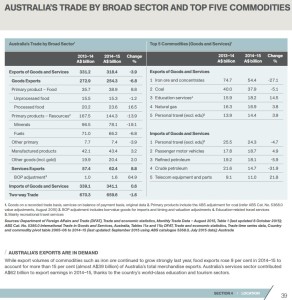
1.(1)オーストラリア連邦(Commonwealth of Australia)基礎データ 平成27年11月11日 の「経済」の「9 総貿易額及び主要貿易相手国」によると、オーストラリアの2013/14年度の
貿易総額は6,692億豪ドル、相手国は中国23.9%・日本10.8%・米国8.7%、
輸出額は3,312億豪ドル、相手国は中国32.5%・日本15.4%・韓国6.8%、
輸入額は3,380億豪ドル、相手国は中国15.4%・米国12.2%・日本6.3% となっています。
 また、「10 主要貿易品目」によると、
輸出は鉄鉱石(22.6%)・石炭(12.1%)・個人旅行サービス(9.0%)、
輸入は個人旅行サービス(8.2%)・原油(6.7%)・精製油(6.0%)
となっています。

(2)「二国間関係」の「3 経済関係」によると、日豪二国間貿易(2014年、財のみ)は、
貿易総額約6兆5,909億円、
輸出(日本→豪州)約1兆5,012億円、
輸入(豪州→日本)約5兆0,897億円、
となっています。
 また、主要品目は、
輸出(日本→豪州)では自動車(47.3%)・石油製品(16.4%)・電気機器(4.0%)・ゴムタイヤ及びチューブ(3.4%)・建設用鉱山用機械(2.7%)、
輸入(豪州→日本)では石油ガス類(33.0%)・石炭(26.2%)・鉄鉱石(17.8%)・非鉄金属鉱(4.3%)・牛肉(3.3%)、
となっています。
 そして、日本の対豪直接投資残高は約661億豪ドルとなっています。
 なお、日豪経済連携協定が2015年1月15日に発効しています。

ほか参考:
オーストラリア輸出統計(国・地域別) 最終更新日:2016年1月28日 | JETRO
世界経済のネタ帳 オーストラリアの貿易

2.(1)オーストラリアからの輸入 ー 産業情報 | @Austrade @AusUnlimited に主要分野として、
・ クリエイティブ(映画・テレビ、音楽産業、芸術・出版)
・ バイオテクノロジー
・ クリーンエネルギー・省エネ(概況、事例紹介、政策支援、ニュース)
・ インフラ・資源開発(建設、航空・空港、資源開発)
・ 金融サービス(アセット・ベース・ファイナンス/リース、ファンドマネジメント、ヘッジファンド、保険、投資銀行、支払・決済システム、プライベート・バンキング、プライベート・エクイティ/ベンチャー・キャピタル、リテール・バンキング)
・ 消費財(化粧品、ファッション、宝石)
・ 食品・飲料・農水産物(概要、農水産物、加工食品・飲料、ワイン、ネイティブ・フード、オーストラリア食品カタログ、食品関連ニュース)
・ 環境技術(グリーンビルディング・その他の環境技術のケーススタディ、その他オーストラリアの環境関連企業)
・ 医療機器とヘルスケア産業(治療機器及び手術用具・設備、ヘルスIT、保健インフラとサービス、臨床試験)
・ 情報通信技術(製品開発(R&D)施設、コンテンツ開発、技術支援センター、グローバルソーシング)
・ サービス産業(コンサルティング・アドバイザリー、法務サービス、物流、フランチャイズ)
・ スポーツ・オリンピック(2012年ロンドンオリンピック ~ スポーツ分野でのオーストラリア企業の成功例)
・ 資源技術・専門性
・ グローバル人材育成(多文化・多民族国家で世界に通じるグローバルなビジネススキルを習得できる;世界で最もグローバルな教育環境でグローバルなセンスを磨ける;グローバル化のニーズにあった研修プログラムが充実;安心して社員を送れる理想的な海外研修先)
が挙げられ、それぞれに概況や各種情報が掲載されています。

(2)また、オーストラリアへの投資 ー 分野別概況 | @Austrade @AusUnlimited には一覧として、
・ 再生可能エネルギー・環境(上記(1)「クリーンエネルギー・省エネ」)
・ エネルギー効率化
・ バイオ燃料
・ 風力発電
・ 太陽光発電
・ 鉱業と資源(豊富で多様な鉱物資源、高度な採掘装置・技術・サービス、投資のチャンス)
・ 水関連事業
・ 建築・建設(建築建設サービス、建築用品と材料、グリーンビル)
・ ICT産業(急成長を遂げるダイナミックな市場)
・ プロフェッショナル・ビジネスサービス
・ 金融サービス
・ バイオテクノロジー
・ 食品飲料
・ インフラ ~ 洗練されたPPP
・ 農林水産物
が挙げられ、それぞれに概況が掲載されています。

(3)なお、上記(1)及び(2)は、
・ クリーン(再生可能)エネルギー
・ インフラ(建設)
・ 情報通信技術(ICT)
・ 金融
・ (プロフェッショナル・ビジネス)サービス産業
・ 資源
・ 食品飲料・農水産物
・ バイオテクノロジー
などを共通して挙げています。

(4)Why Australia: Benchmark Report (PDF) の p.9: AUSTRALIA’S REAL GROSS VALUE ADDED BY INDUSTRY では、
・ Financial and Insurance 9.3%
・ Mining 9.3%
・ Construction 8.2%
・ Health Care and Social Assistance 7.0%
・ Manufacturing 6.6%
・ Professional, Scientific and Technical 6.4%
・ Education and Training 4.9%
・ Transport, Postal and Warehousing 4.9%
・ Information Media and Telecommunications 3.2%
・ Agriculture, Forestry and Fishing 2.4%
などとされています。
 また、同 p.10: GROWTH BY INDUSTRY IN AUSTRALIA’S REAL GROSS VALUE ADDED (All-Industries Average 3.2%) では、
・ Information Media and Telecommunications 5.3%
・ Professional, Scientific and Technical Services 5.0%
・ Construction 4.6%
・ Financial and Insurance Services 4.5%
・ Mining 4.4%
・ Health Care and Social Assistance 4.2%
・ Transport, Postal and Warehousing 3.5%
・ Agriculture, Forestry and Fishing 3.0%
などとされています。

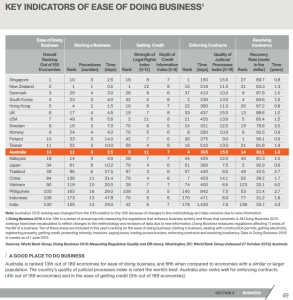
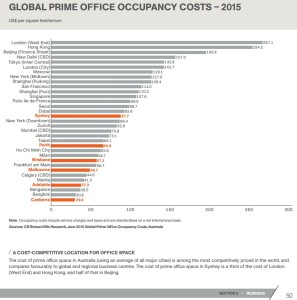
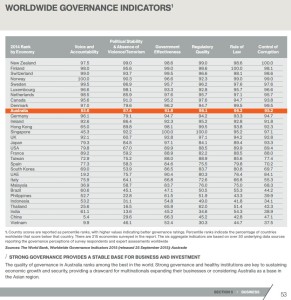
 加えて(p.8,12,20,24,32,39,42,44,48,49,50,53を下に貼っておきます)、
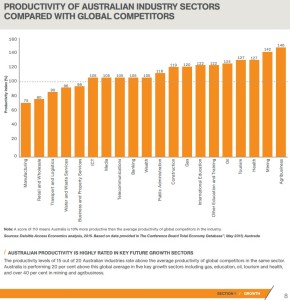
p.8: PRODUCTIVITY OF AUSTRALIAN INDUSTRY SECTORS COMPARED WITH GLOBAL COMPETITORS
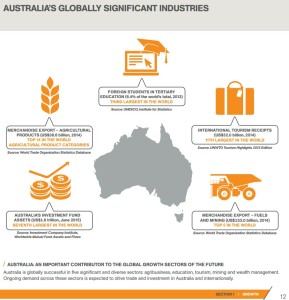
p.12: AUSTRALIA’S GLOBALLY SIGNIFICANT INDUSTRIES
p.13: AUSTRALIA’S ENERGY AND RESOURCES SECTOR
p.14: TOP 10 EXPORT DESTINATIONS FOR AUSTRALIAN FOOD AND FIBRE
p.16: DISTRIBUTION OF FOREIGN STUDENTS IN TERTIARY EDUCATION BY COUNTRY OF DESTINATION – 2013
p.17: GLOBAL SIGNIFICANCE OF AUSTRALIA’S INVESTMENT FUND ASSETS POOL
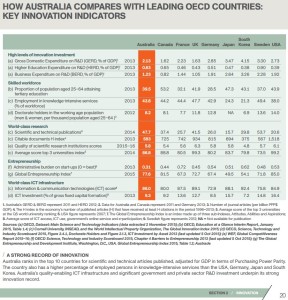
p.20: HOW AUSTRALIA COMPARES WITH LEADING OECD COUNTRIES: KEY INNOVATION INDICATORS
p.22: WORLD OF RESEARCH AND DEVELOPMENT
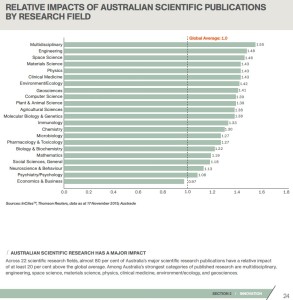
p.24: RELATIVE IMPACTS OF AUSTRALIAN SCIENTIFIC PUBLICATIONS BY RESEARCH FIELD
p.30: AUSTRALIA’S EMPLOYED PERSONS BY INDUSTRY – 2015
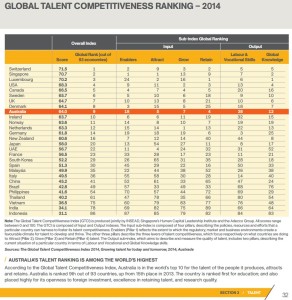
p.32: GLOBAL TALENT COMPETITIVENESS RANKING – 2014
p.36: FOREIGN-BORN POPULATION
p.39: AUSTRALIA’S TRADE BY BROAD SECTOR AND TOP FIVE COMMODITIES
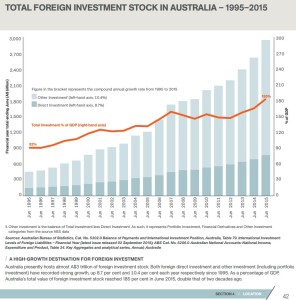
p.42: TOTAL FOREIGN INVESTMENT STOCK IN AUSTRALIA – 1995–2015
p.43: AUSTRALIA’S SHARE OF GLOBAL FOREIGN DIRECT INVESTMENT STOCK – 2004–14
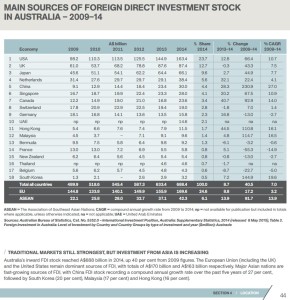
p.44: MAIN SOURCES OF FOREIGN DIRECT INVESTMENT STOCK IN AUSTRALIA – 2009–14
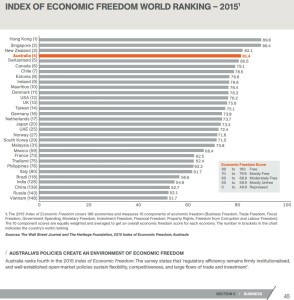
p.48: INDEX OF ECONOMIC FREEDOM WORLD RANKING – 2015
p.49: KEY INDICATORS OF EASE OF DOING BUSINESS
p.50: GLOBAL PRIME OFFICE OCCUPANCY COSTS – 2015
p.51: REMUNERATION OF MANAGEMENT
p.52: BUSINESS EFFICIENCY AND ENVIRONMENT – 2015
p.53: WORLDWIDE GOVERNANCE INDICATORS
など各種の有用なデータが含まれています。
p.8p.12p.20p.24p.32p.39p.42p.44p.48p.49p.50p.53

ツイッター paper.li Vol.3

All the below links are in English.

弊社ツイッターアカウントの一つ @WSjp_insight のRTによるpaper.li掲載記事5件を貼っておきます。

Brexit is already proving to be a huge victory for global free trade | @LSolomonTweets

A chocolate bar from Canada won 1st prize | @RCInet

About Renewable Energy | @NRCan

This year, Oscar speaks with an Irish accent | @BarryODowd_Irl

San Diego to become largest U.S. city to run on 100% renewable energy | @envirojourno @inhabitat

Canada カナダ Vol.3

(Most of the links in 1. are in Japanese, and those in 2. are in English.)

日本・カナダ間の貿易・投資関連概観 及び カナダ連邦及び各州の主要経済分野 です。

1. 日加経済 平成28年2月4日 の カナダ経済と日加経済関係 (PDF) p.3,4,9,10,11 に日加間貿易・投資関連データが掲載されています。
日本からカナダへの輸出は
輸送用機器(自動車を含む)、一般機械、電気機器など、
日本のカナダからの輸入は
菜種、金属鉱、石炭・コークス及びれん炭、木材及びコルク、肉類及び同調製品、穀物及び同調製品、医薬品、魚介類及び同調製品など、
です。
 また、日加首脳会談 平成28年5月24日 の 3(3) にあるとおり、インフラ、エネルギー、科学技術、ビジネス環境・投資、観光・学生交流の5分野に焦点を当て両国間の協力を進めることとされています。

ほか参考:
カナダ(Canada) 基礎データ 平成28年2月23日
世界のインフラは量のみならず質も重視する時代へ(動画)(平成28年5月19日)
「質の高いインフラ輸出拡大イニシアティブ」(首相官邸ホームページへリンク)(平成28年5月23日)(PDF)
質の高いインフラ投資の推進のためのG7伊勢志摩原則 (PDF)
カナダの基礎情報 | 海外建設・不動産市場データベース
原子力安全セキュリティ・グループ(NSSG)報告書 (PDF)
自動走行車・燃料電池自動車プレゼンテーション 平成28年5月26日
競争力の優位性 | The Canadian Trade Commissioner Service
SR&ED優遇税制 | The Canadian Trade Commissioner Service
“Policy Package for Promoting Foreign Direct Investment into Japan to Make Japan a Global Hub” (May 20, 2016)(PDF:115KB)
“Five Promises for Attracting Foreign Businesses to Japan” (March 17, 2015) (PDF:90KB)
日・カナダ科学技術協力 平成25年2月1日
投資/科学技術 | @CanEmbJapan

2. カナダ各州の主要経済分野に係る情報は、例えば、以下のものがあります。
(1)オンタリオ州 Ontario
 Industries | @InvestOntario(頁下部)では、Aerospace、Automotive、Chemical and biochemical、Financial services、Food and beverage manufacturing、Industrial Automation and Robotics、Information technology、Life sciences、Mining、Tourism、Water technology の11分野が挙げられ、それぞれにおいて多くの情報が掲載されています。

(2)ブリティッシュコロンビア州 British Columbia
 産業セクター | @BCTradeInvest では、農業食品、林業、鉱業、天然ガス、テクノロジー、観光、運輸 の7分野が挙げられ、それぞれにおいて主な利点、概略、統計、支援、インセンティブ、サクセスストーリー、インフラなどの項目が立てられ、多くの情報が掲載されています。

(3)ケベック州 Quebec
 INDUSTRIES | @InvestQuebec では、AEROSPACE、AGRI-FOOD、GROUND TRANSPORTATION、INFORMATION AND COMMUNICATION TECHNOLOGIES、LIFE SCIENCES、MICROELECTRONICS、MINING、MULTIMEDIA の8分野が挙げられ、それぞれにおいて多くの情報が掲載されています。

(4)アルバータ州 Alberta
 AlbertaCanada.com (@YourAlberta) では、 「アルバータ州の産業に関する詳しい情報は、以下をご覧ください。」とされて、航空宇宙・防衛機器、農業・畜産食品、建築製品・技術、工学・建造技術、環境製品・サービス、金融サービス、工業製造、情報通信技術、生命科学、物流と市場へのアクセス、原油・ガス、精製、石油化学、生化学製品、観光の13分野が挙げられ、それぞれにおいて概要が説明されています。

(5)マニトバ州 Manitoba
 Growth, Enterprise and Trade | @MBGov では、Key Industry Sectors として Aerospace、Agribusiness: Food Processing、Agribusiness Manufacturing & Technology、Building Products、Education、Electricity、Environmental Industries、Financial Services、Heavy Vehicle Manufacturing、Information & Communications Technologies & Media、Mining, Minerals & Petroleum、Retail、Tourism、Transportation & Logistics の14分野が挙げられ、それぞれにおいて概要等が掲載されています。

(6)サスカチュワン州 Saskatchewan
 OUR KEY ECONOMIC SECTORS | @SKGov では、”The sectors listed below have been identified as having the most potential for economic growth.” とされて、Agriculture & Agri-Value、Energy、Forestry、Life Sciences & Biomass、Manufacturing、Minerals の6分野が挙げられ、それぞれにおいて概要説明やまとめPDF等が掲載されています。

(7)ニューファンドランド・ラブラドール州 Newfoundland and Labrador
 Supporting Business Sectors | Department of Business, Tourism, Culture and Rural Development @GovNL では、”Strategic sector development focuses on the development and implementation of industry strategies to take advantage of new business opportunities. The department works closely with industry, economic development groups, the federal and provincial governments to develop and implement strategies that support the growth and diversification of strategic sectors.” とされて、Aerospace and Defence、Agrifoods、Craft and Gift、Environmental Industries、Information and Communications Technology、Life Sciences/Biotechnology、Manufacturing、Ocean Technology and Arctic Opportunities の8分野が挙げられ、それぞれにおいて概要が掲載されています。

(8)プリンスエドワードアイランド州  Prince Edward Island
 STRATEGIC SECTORS | @Innovation_PEI (@InfoPEI) では、”Prince Edward Island is developing a solid reputation as the location of choice for many leading international companies. Regardless of sector, we have a variety of financial supports and services to support the Island’s economic growth. Since the early 1990’s, the province’s economy has undergone considerable growth particularly in high knowledge sectors such as: Aerospace and defence, Bioscience, and Information communications technology. As these sectors have grown, our need for primary industries has faded. There is little to suggest these trends will not continue. Along with these trends and our province’s economic strategy, we are focusing on five main growth sectors: ” とされて、Information and Communications Technology、BIO Science、Aerospace and Defence、Renewable Energy、Financial & Business Services、Marine の6分野が挙げられ、それぞれにおいて概要説明やビデオ等が掲載されています。その後、社会的・経済的に成長している分野として、Advanced Manufacturing and Processing including value-added food development and production、Financial Services、Small Business が挙げられています。

ほか参考:
TradeTeamPEI
Invest PEI

(9)ノバスコシア州 Nova Scotia
 Our Growth Sectors | @NSBI では、Agriculture and Agri-Food、Clean Technology、Defence, Security & Aerospace、Digital Media、Financial Services、Information Communications Technology、Life Sciences、Manufacturing、Ocean Technology の9分野が挙げられ、それぞれにおいて企業・組織名を挙げた概要説明等が掲載されています。@NSBI は、
@ns_dob  の一番下に紹介されています。
 また、Industry Sectors | @hfxnovascotia では、Oceans、Life Sciences、Aerospace & Defence、Finance & Insurance、Education の5分野が挙げられ、それぞれにおいて概要説明やビデオ等が掲載されています。

(10)ニューブランズウィック州  New Brunswick
 rebuilding New Brunswick [PDF] | @Gov_NB では、Aerospace and Defence、Biosciences、Information and Communications Technology、Industrial Fabrication、Value-Added Food、Value-Added Wood の6分野が2012-16年の経済成長重点分野として挙げられています。また、Industry | @Gov_NB では、Forestry、Fishing、Mining、Construction、Manufacturing、Food Service の6分野が挙げられています。

(11)ユーコン準州  Yukon
 Priority Sectors | @InvestYukon では、Film and Sound、Forestry、 Innovation and Technology、Mining and Exploration、Oil and Gas、Tourism and Culture の6分野が挙げられ、それぞれにおいて概要説明等多くの情報が掲載されています。

(12)ノースウェスト準州 Northwest Territories
 Sectors | Industry, Tourism and Investment @ Government of the Northwest Territories では、”There are ten areas of focus identified by the Department for which programs and services are delivered directly or indirectly: ” とされて、Business and Economic Development、Traditional Economy、Tourism、Parks、Mines & Minerals、Diamonds、Oil & Gas、Arts, Crafts, and Film、Agriculture & Fisheries、NWT Geological Survey の10分野が挙げられ、それぞれにおいて概要説明等多くの情報が掲載されています。

(13)ヌナブト準州 Nunavut
 Department of Executive and Intergovernmental Affairs @GOVofNUNAVUT では、Economy として Mineral Exploration and Mining、Traditional Harvesting、Fisheries、Tourism、Inuit art の5分野が挙げられています。

(14) なお、Explore Canada | The Canadian Trade Commissioner Service にも、Sector Strengths(主要経済分野)も含めたカナダ各州・都市の経済情勢等が掲載されています。

3. Innovation, Science and Economic Development Canada (@MinisterISED) で “Export” “Import” と “Invest in Canada” について調べることができます。
 後者については、”It’s no wonder that Canada is a recognized world leader in many industries” とされて、Aerospace、Automotive(工場一覧にホンダ及びトヨタの記載有り)、Information and Communications Technologies、Shipbuilding の4分野が挙げられ、それぞれにおいて企業や政策の紹介、また、検索コーナーなどが掲載されています。
 前者については、- Search by product において検出された2015年の、カナダの輸出先国及び金額、カナダの輸入元国及び金額、13(準含む)各州から日本への最大輸出品目及び金額 を以下貼っておきます。
Canada export 2015Canada import 2015
Ontario largest to Japan 2015
BC largest to Japan 2015
Quebec largest to Japan 2015
Alberta largest to Japan 2015
Manitoba largest to Japan 2015
Sask largest to Japan 2015
NL largest to Japan 2015
PEI largest to Japan 2015
NS largest to Japan 2015
NB largest to Japan 2015
Yukon largest to Japan 2015
NWT largest to Japan 2015
Nunavut largest to Japan 2015

New Zealand ニュージーランド Vol.2

3点ご紹介します。

1. @NZTEnews (New Zealand Trade & Enterprise ニュージーランド貿易経済促進庁) annual report 2014/15 [PDF] は、同庁の2014/15年の年次レポートです。具体的数字を挙げた要点(p.2)は、以下のとおり。
・ 2014年には、NZTEと提携する企業を増やし国際的ネットワークを創るために、4年以上に亘り6900万ドルの追加投資をすることを決めた。(… In 2014, as part of the Business Growth Agenda (BGA), the Government committed an additional investment of $69m over four years, targeted at increasing the number of companies we work with and growing our international network. …)
・ また、2014/15年には、我々のF700(*1)の顧客たる企業の国際収益は、2013/14年から67億ドル増の340億ドルであった。前年より3億ドル以上増の11億ドルの収益を顧客企業と共に新規輸出において産み出し、また、91%の顧客企業がF700による付加価値を認めた。 14.5億ドルの直接的な経済的インパクトの可能性のある、8億6600万ドルの資本の展開を手助けした。(… In 2014/15, international revenue for customers in our F700 portfolio was $34b, up $6.7b from last year, with a portfolio growth rate of 8.7%. We worked with customers to generate $1.1b in new export deals, over $300m more than last year, and 91% of our customers said that we added value to their business. To support growth, we helped deploy $866m of capital, with a potential direct economic impact for New Zealand of $1.45b. …)
* NZ政府と企業が連携して国際展開を図るスキームであり、700社が対象。参考:https://www.nzte.govt.nz/en/how-nzte-can-help/
※ なお、ニュージーランド外交貿易省(@mfat:Ministry of Foreign Affairs and Trade)の2014/15年次レポート(NZTEレポートとは特に具体的には関連付けられてはいない)は、https://www.mfat.govt.nz/assets/_securedfiles/MFAT-Corporate-publications/MFAT-Annual-Report-2014-2015.pdf

2. Regions of opportunity – Find out which New Zealand region matches your investment interests by comparing each region’s sector strengths and how these are supported by the region’s workforce, raw materials, services and infrastructure. [PDF] | @NZTEnews は、同庁が投資の観点から各地方を紹介しています(2014年7月)。主な投資考慮対象等は、以下のとおり。
・ ノースランド地方: 造船(p.3)、木材(p.4)、養殖漁業(p.5)。日本企業 Juken New Zealand Ltd が紹介されている(p.6)。
・ オークランド地方: 情報通信(p.11)、食品加工(p.12)、農業技術・海洋・航空等の高額製造業(p.13)。日本企業 Asahi が紹介されている(p.14)。
・ ワイカト地方: 様々な高額製造業(p.19)、ロジスティクス(p.20)、付加価値日用品(p.21)。
・ ベイオブプレンティ地方: 高品質で費用効果の良い木材(p.27)、チタン製造や海洋エンジニアリングなどの高額製造業(p.28)、アボガドやキウイフルーツなどの食料(p.29)。
・ ギズボーン地方: 木材(p.35)、羊・牛/穀物/単一品種白ワイン(p.36)、食品・飲料製造(p.37)。 日本企業 Cedenco Foods New Zealand Ltd 及び Juken New Zealand Ltd が紹介されている(p.38)。
・ ホークスベイ地方: 園芸/牛・羊/ブドウ栽培/野菜など(p.43)、果物・野菜加工/ワイン製造など(p.44)、事務所サービス(p.45)。日本企業 Oji Holdings Corporation が紹介されている(p.46)。
・ マナワツ・ワンガヌイ地方: アグリビジネス(p.51)、食料イノベーション(p.52)、コンタクトセンター(p.53)。日本企業 Toyota が紹介されている(p.54)。
・ タラナキ地方: 原油・天然ガス(p.59)、肉類・食品添加物など(p.60)、石油化学などエンジニアリング(p.61)。日本企業との企業 ANZCO Foods が紹介されている(p.62)。
・ ウェリントン地方: 映像産業(p.67)、デジタル技術(p.68)、コンタクトセンター(p.69)。日本企業 Fujitsu New Zealand 及び Juken New Zealand Ltd が紹介されている(p.70)。
・ ネルソン・タスマン・マールボロ地方: ワイン・りんご/緑イ貝養殖など(p.75)、海洋・航空エンジニアリング(p.76)、付加価値木材製品(p.77)。 日本企業 Nelson Pine Industries が紹介されている(p.78)。
・ ウェストコースト地方: 鉱物(p.83)、山羊・乳製品/園芸(フェイジョア・クランベリー・ブルーベリー・カラーリリー)(p.84)、観光(p.85)。
・ カンタベリー地方: 食品加工・農業技術研究など(p.91)、健康・農業・ソフトウェアなど知識集約型産業(p.92)、建設・インフラ(p.93)。日本企業 Allied Telesis Labs 及び 日本企業出資企業 Synlait Milk が紹介されている(p.94)。
・ オタゴ地方: デザイン技術・高額製造業(p.99)、観光・エコツーリズム(p.100)、果物・ワイン(p.101)。
・ サウスランド地方: 食品(食肉・オーツミルク・大麦・小麦)・飲料(p.107)、鉱物・金属部品(p.108)、宇宙産業(p.109)。日本企業 Otsuka Diatranz 及び 日本企業出資企業 New Zealand Aluminium Smelters (NZAS) が紹介されている(p.110)。

3. NEW ZEALAND ECONOMICS: @ANZ_NZ ECONOMIC OUTLOOK “ROLLING WITH THE PUNCHES” [PDF](2016年7月)では、ニュージーランド経済の現況が説明されています。要点は以下のとおり。
・ 国内経済(p.2-6): 好調持続、今後3年も3%弱の成長を維持できる見通し。酪農製品の輸出不調及びNZドル高によるマイナス効果を、酪農以外の輸出、建設、移民関連、住宅、サービス業、観光の好調が上回っている。(The New Zealand economy continues to perform well and we expect more of the same over the years ahead, with growth averaging close 3% per year over the next three years. Challenges in dairying and a high NZD are being outweighed by non-dairy exports, construction, migration, housing, services and tourism. Solid demand will see capacity constraints come more to the fore. …)
・ 国際経済(p.7): 日欧はどんよりした見通し、アメリカはよく闘い抜いている。(While our global growth forecasts depict a reasonable outlook, this masks considerable tension and risks. High leverage, investment misallocation and a populist-driven backlash against globalisation are a potent mix. Prospects for Europe and Japan are sombre. Emerging market economies, including China, face transitional challenges. The exception is the US, which is battling on nicely.)
・ 主要分野(p.8): 酪農(牛乳、羊肉、牛肉、羊毛)不調、園芸(ワイン、ピップフルーツ、キウイフルーツ)好調。この二極化は2016/17年も続く見通し。(The dichotomy across key primary sectors is expected to continue in 2016/17. The operating environment looks challenging for key livestock sectors. Dairy farmers are facing their third low payout year and second year of cash losses. Cuts in discretionary spend will continue. In the red meat and fibre sector there are knock-on impacts from dairying on arable and support prices. The reason for sheepmeat and venison price increases is lower New Zealand supply. In contrast, the main horticultural crops are on track to post near-record export volumes with solid prices lifting revenues and bottom-line returns.)
・ 金融市場(p.9-11): OCR(銀行間の資金取引に適用される翌日物貸出金利)下げが短期的になされるという見通しに気乗りしない。(We are lukewarm over prospects for the OCR moving lower in the short-term; amidst housing largesse the economy simply doesn’t need more easing right now. We expect the RBNZ to hold fire in August. Short-end interest rates are still biased lower over time, with more OCR cuts likely down the track. We see an elevated TWI and global risks ultimately bringing the RBNZ back to the easing table. The Brexit vote has created significant uncertainty, increased the likelihood of further easing in Europe, the UK and Japan, and side-lined the Fed. Against that backdrop, we expect the NZD and local interest rate markets to be well supported, in the absence of a meltdown across emerging markets (which, to be fair, is a key risk). Last quarter we were of the view that Fed tightening and RBNZ easing would see the curve steepen, but Brexit has turned that on its head; and we now expect global yield curves to flatten as markets adjust to a prolonged period of uncertainty and easy policy. )